

You are probably thinking, isn't this supposed to be about business cards? Hang with me. We're going on a journey that will give you a clear understanding of what a business card can do for your brand.
Oevae has landed 3, 4, 5, or more clients because of Ricardo's branding. Most say his brand is really eye-catching. And others comment on his business cards. Note: 80 percent of Ricardo's business is generated face-to-face, as it should be in his line of business. This includes referrals from his past clients.
So this means? The Wedding Architect's business cards are dangerously important to the wedding planner, wedding consultant, wedding professional, and wedding industry as a whole.
Why three seconds to read a business card?
Think about the last time you had a conversation with someone you found to be interested in what you had to offer or your new business. This is a person that you've never seen before in your life, and chances are you may never see this person again.
Now then.
While standing, sitting, lounging... whatever it is you do when you communicate, at some point in time you pass your business card(s) to this person of interest. After you hand your card over, the person receiving the card normally (hopefully) says "thanks" or "okay, great" and then looks at your card for 3 seconds tops. For this reason, your business cards need to be the shiznit (great).
Anyway, that's only part of the solution.
Knowing you can use a business card to capture attention like a wedding planner might do. But what does it take, or where do you get business cards? Well, there's FedEx Office (formerly FedEx Kinko's, formerly Kinko's), Office Max, Office Depot, GoPrint, Staples, Speedy Print, Overnight Prints, MOO, 4by6, and a host of other business card printers online and probably not far from where you are right now.
What about adding the Wow factor to the business card?
Who would have thought, in today's world, we would still be using business cards? Please. As long as we have magazines or until cell phones are free. The staple business card will be around.
The point here is that you'll most likely need a business card if your industry uses them (business cards) as a mode in which business can be conducted. However, I doubt that Michael Phelps really needs a business card to promote his business. He's a pretty well-known guy. I think he's doing okay in the branding department. But not everyone can have it like an Olympic Gold Medalist with 120 of your faces on aisle #12 at the grocery store, ear to ear on the Wheaties box. No. Not everyone has that much exposure.
Take advantage of the business card in a positive way. Not pushy—shrewd, but not hurting anyone—as you would normally do while attending a business conference, at your child's parent-teacher meeting, during a business mixer or happy hour, while talking to some random guy in line at Walmart while holding a box of "unmentionables" under your arm.
Come on, compliments are normally for great hair and/or a great meal. Receiving a compliment on a business card that is only 2 inches by 3.5 inches and just a bit thinner than a dime, that's a big deal.
Business cards are very important when used to strategically market your brand, build your key relationships, or pray for that next big referral. Stay consistent and work on your plan. Business cards are a part of your marketing plan if you communicate with people face-to-face for business. Leave your business card with your tip at a nice restaurant or with people you meet at the gym or yoga studio.
Our business cards were the most expensive cards we could afford when we first started Oevae back in 1999. We had a mound of creativity and many different cards for the first few years while we molded the final brand in 2001 into what it is today. In the beginning, we knew that black-and-white printing was the least expensive, so we could cut printing costs. Today, it's all the same. Back then, we needed some way of holding our prospect's attention for more than 3 seconds.
Yeah, we want more than 3 seconds.
When we planned to make Oevae Marketing Consultants, we needed to express what our creative marketing was about and tell it quickly with something they would taste later. We needed our business card to cut through a stack like a hot knife through cold butter. We've used a business card that looked like a poker chip, and another that was a replica of the slip of paper from a fortune cookie. The winning numbers? You guessed it, the company phone number.
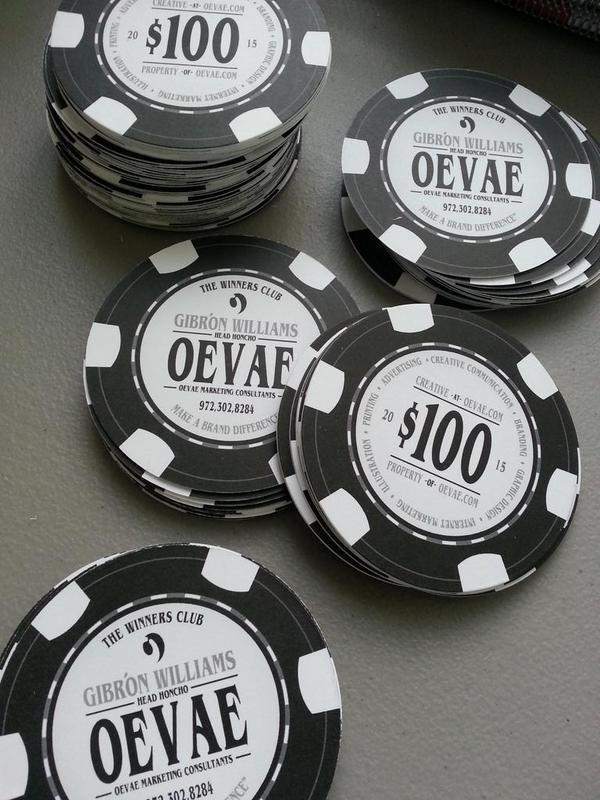
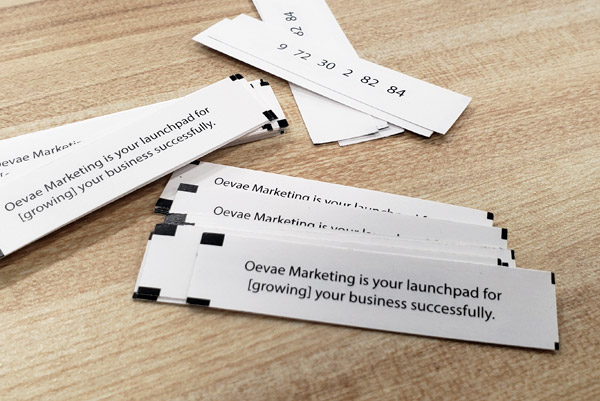
This has led many new clients—and now friends—our way. So I may be slightly biased in my opinion. But again, the business card orders keep coming our way. Our clients keep telling me how much people admire their business cards and where they get them printed.
2026 update: the digital card didn’t kill the business card
Digital business cards are easy. No print run, no box of cards, and an NFC tap can move your name, number, website, and contact details into somebody's phone in seconds. That's cool. But that convenience can also shorten the life of the impression. Once the contact is saved, it becomes one more record in a device. The recipient has to remember your name — or remember why they saved you — to go looking for you again.
The standard business card has a different job because it is visual and tangible. People touch it, hold it, feel it, and, even if the value is minimal, they have to find a home for it. Put it in a pocket, and it comes back out: second impression. File it with other business cards, and it may be seen again and again. Each view gives the recipient another chance to think, “Who was that?” and replant the brand in their mind.
Repetition and multiple views are essential because consumers rarely buy a product the first time they see it, requiring multiple touchpoints to build the trust and familiarity needed to make a purchase. In marketing, this is driven by the "Rule of 7," which states that a potential customer needs to see a brand's message at least seven times before they will take action. Each repeated view cuts through online noise, reinforces your credibility, and transitions a consumer from basic awareness to an active buying decision. By consistently showing your offer across different moments, you ensure your business stays top-of-mind exactly when a customer is finally ready to buy.
“Business cards can add more theatre to that in-person experience — something that can’t be replicated by an online process.”Rick Byrne, PRINT Magazine
And the physical card can carry the digital layer with it. A QR code, NFC tag, website, vCard, or Mini Link can give the same instant access as a digital card while the printed object keeps working after the scan. Heavy stock can communicate weight and value before a word is read. Texture, scent, shape, die cuts, and even utility can turn a small card into a piece of the brand experience. A round card can double as a desk coaster. A scratch-and-smell business card shaped like a donut — hole in the center — for a mobile bakery can end up on a desk or in a kid's hands. That's a longer visual lifespan and multiple views, more like a tiny billboard than a one-time contact transfer.
You meet someone with a digital card, and the NFC tap is cool because it still feels new in some settings. But after they walk away, the contact can disappear into the phone. The physical card can sit on the desk, ride in a wallet, fall out of a pocket, get passed to somebody else, or become the thing that reminds them of the person and the experience.
You really do need business cards, even in a tech-savvy arena. Why? Because, in face-to-face business, a well-designed physical card can be more practical, more effective, and just as fast as a digital tap—but with deeper meaning and a longer visual life. Add QR or NFC, and it can carry the digital layer too. That's almost a no-brainer.
