Tuesday, August 25, 2026

Maximize the Benefits of Change: Mobility35 Small Business Roadmap

Construction. Traffic. Road Closed.

How Smart Businesses can Redirect Opportunity and Maximize the Benefits of Change During Mobility35 and I-35 Construction
Mobility35 and I-35 construction small business opportunity in Austin Texas
10 years ago (August 24, 2016), P. Terry's Burger Stand opened a flagship restaurant at Capital Plaza beside I-35. The building was created to be noticed. Its dramatic, futuristic Michael Hsu roofline reached toward the highway and turned architecture into advertising.

Today, ten years later, that building is gone — not because the burgers stopped selling or the brand stopped growing, but because the environment around the business changed. And perhaps, one of the clearest lessons a small-business owner can take from the enormous transformation underway along I-35. A smart strategy can be right for years and still have to change when the world around it changes.

P. Terry's had done many of the things businesses are told to do. It chose a high-traffic location, aligned itself with a major transportation corridor, invested in memorable design and deliberately chose Extreme Branding so the building itself communicated before a passing driver ever read the restaurant's name.

The strategy worked. The restaurant became a landmark. Then the artery changed.

“It just became a billboard for us for the last 10 years.” P. Terry's co-founder Patrick Terry, discussing the Capital Plaza flagship.

Change Doesn't Ask Permission From the Business Plan

For businesses around Rundberg Lane, Braker Lane and the surrounding North Austin corridor, the problem is usually less dramatic than losing an entire building, but the principle is the same. Mobility35 construction is changing the physical environment customers learned to navigate.

An entrance moves. A ramp closes. Construction barrels obscure a driveway. A familiar turn becomes inconvenient. A five-minute lunch trip can become a twenty-minute nuisance.

The business can be fully open and ready to serve while appearing, from the driver's perspective, difficult to reach.

That makes this a communication problem before it becomes a marketing problem.

TxDOT has to explain how motorists move through a massive transportation project. The business owner has a simpler responsibility: tell the customer how to get to the front door today.

Customer Road Map

Here's the idea behind a Customer Road Map. Instead of asking customers to interpret a construction diagram, give them the pieces of information they actually need: the best exit, the available entrance, where to park and whether another route will save time.

A QR code connected to a Mini Link can make that information flexible. The same code printed on a window, receipt, menu or temporary sign can point to the best route today and a different route next week. The physical communication stays in place while the information behind it changes.

That is why a QR Code Machine and Mini Link make sense in a construction environment. They are not interesting because they are technology. They are useful because they allow communication to move when the road moves.

Businesses should also keep up with current Mobility35 information rather than waiting for customers to explain the latest closure. TxDOT's Mobility35 site provides current project information, while businesses can also sign up for Mobility35 email updates.

Traffic Doesn't Disappear. It Goes Somewhere.

There is another side to construction that receives considerably less attention.

When a customer decides a familiar restaurant is suddenly too difficult to reach, that person usually does not stop eating lunch. They choose another restaurant.

When an exit becomes inconvenient, the business before the exit may suddenly become more attractive than the business after it. One company loses spontaneous traffic. Another gains it.

So while one owner is asking, “How do I keep my customers coming?”, another small-business owner may be looking at an unexpected increase in traffic and asking, “How do I keep these new people after the construction is over?”

Imagine someone walking into a restaurant and saying, “I normally go farther down the road, but I'm not fighting that construction today.”

The road has just introduced that business to somebody else's customer.

Now the business has to earn the second visit.

Maybe the food is better than expected. Maybe the service is faster. Maybe the customer likes the atmosphere or discovers a lunch special or menu item they never knew existed. They may have arrived because of a detour and return two weeks later because they found something worth returning to.

Construction may create the first visit. The experience creates the second.

That is why temporary traffic should not automatically be treated as temporary business.

Give People Something Worth Traveling For

Directions solve one form of friction. They do not solve the entire decision.

A customer deciding whether to make an inconvenient trip may also want to know what is on the menu, what it costs, what the food looks like and what kind of experience is waiting at the other end.

Real-world examples show how much attention practical and visual information can attract. A CVS photography service menu photograph accumulated 7,963 views. Vaqueros BBQ food truck menu reached 11,661. The Asian Mint reached 35,205 views for a dining area photograph. One restaurants Google Review photograph of the ABC Burger at Wizards Sports Café accumulated 418,206 views, while a six-second Donkey Mo's food Google Review video passes 10,000 views.

Those numbers do not mean every photograph will perform the same way. They demonstrate something more useful: customers consume information visually, and useful or appetizing information can keep working long after it is posted.

The service-menu photograph answers a practical question. The food-truck menu lets somebody make a buying decision before arriving. The restaurant interior sells atmosphere. The food image sells appetite. And six seconds of movement can sometimes communicate more effectively than an elaborate commercial.

Google can provide reach. Your brand should provide the experience.

Google Search, Maps, photographs, video and reviews can introduce somebody to a business. But all of that happens inside Google's environment.

A restaurant's own digital menu or Digital Flipbook can continue the experience with food photography, short video, prices, specials, directions, parking instructions, construction access information and the business's own visual identity.

The goal is not to replace Google. It is to let Google make the introduction while giving the business somewhere of its own to continue the conversation.

A New Guest Can Leave a Longer Digital Trail Than the Visit

More guests can also create more digital exposure.

This is not about pestering every customer for another review. It is about benefiting from the photographs, videos, reviews and detailed experiences people naturally share when something is worth documenting.

A customer visits because the normal route to another restaurant was inconvenient. They try something new. Maybe they take a photograph. Maybe they write about the experience. The business responds.

The meal ends. The digital interaction does not. One review-related image at Donkey Mo's Korean Fried Chicken approached 10,000 views in roughly 30 days.
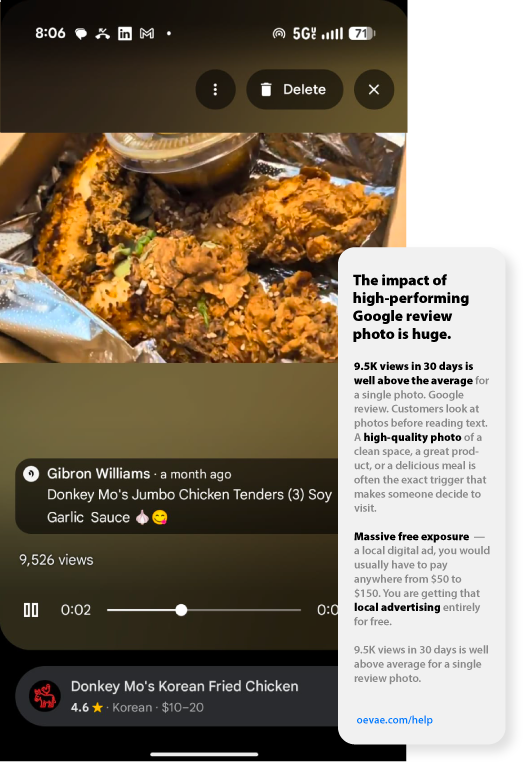
Donkey Mo's Korean Fried Chicken 9K Google Local Guide Google Review image views

Somebody else can discover that contribution tomorrow. Another customer can read it next month. A thoughtful business response remains visible to future customers who were never part of the original transaction.

That is how temporary traffic can begin producing a longer digital tail.

If a business wants to make returning easier, a QR code, Mini Link, branded Digital Flipbook or Lead Capture experience can provide a simple next step. Not because everybody needs to enter a marketing funnel, but because returning should be easier than rediscovering.

The Difference Between a Location and a Business

That brings us back to P. Terry's Burger Stand – The Capital Plaza building mattered precisely because it was not generic. P. Terry's deliberately chose Extreme Branding. Michael Hsu's futuristic roofline, color, geometry and relationship to I-35 were intentional. The building itself became part of the message.

The highway changed. Building demolished. Landmark disappeared.
The brand did not.
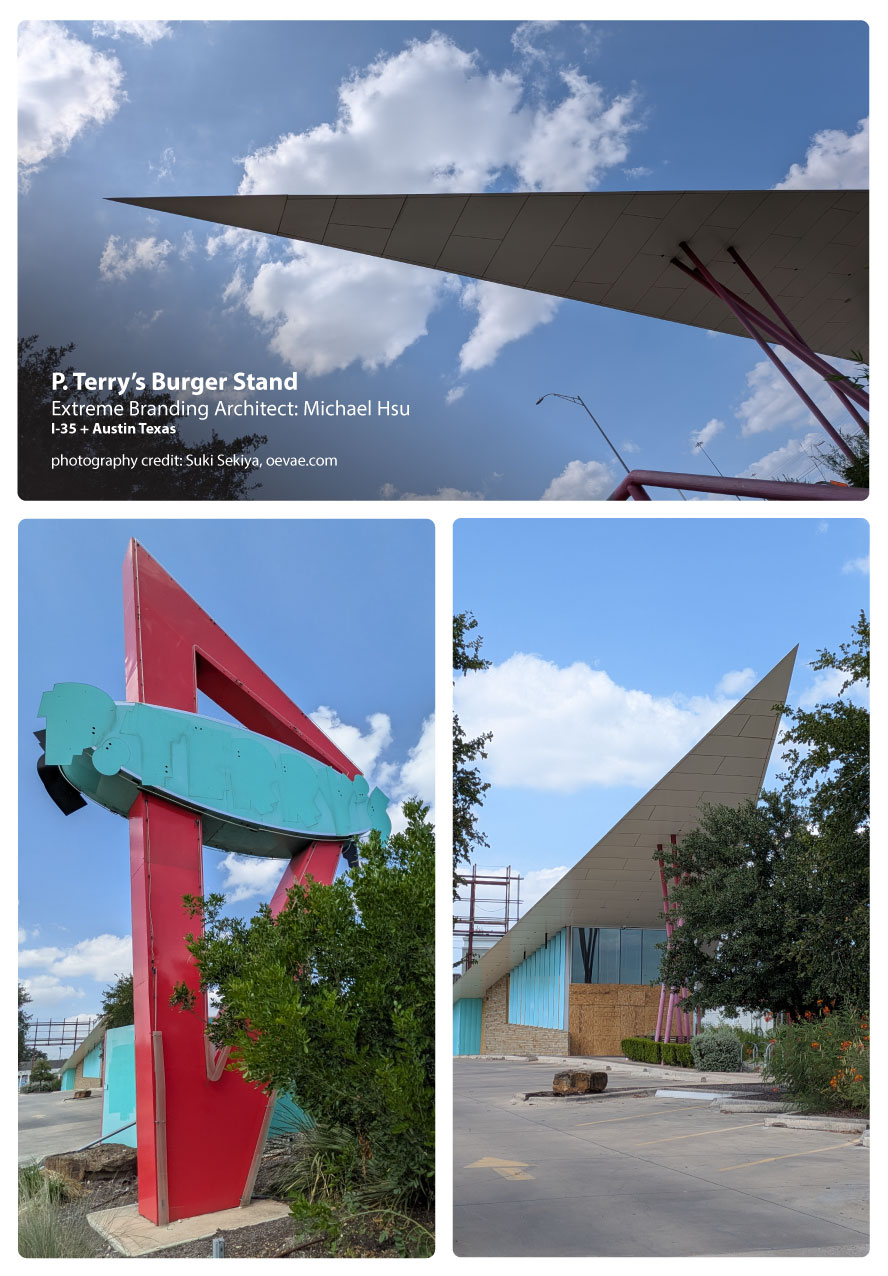
Extreme Branding made the location memorable. Change made the location temporary.
P-Terry's #11 Capital Plaza, Austin, Texas Demolition

Adaptability allows the business to continue.

Small businesses have lived through enough disruption to recognize the larger pattern. COVID accelerated curbside pickup, delivery, digital ordering and contactless transactions. Other major events changed how businesses think about security and access. Technology continually changes how customers discover, evaluate and buy.

Mobility35 is changing something more physical: how people move through Austin.

The disruption itself is not necessarily the opportunity. The response can be.

How Small Businesses Can Maximize the Benefits of Change

For one business, adapting may mean giving regular customers a clearer route to the parking lot. For another, it may mean recognizing that unfamiliar customers are walking through the door because somebody else's route became inconvenient.

Another business may discover that its menu deserves to be easier to find, that a six-second video can communicate appetite, or that Google's reach becomes more valuable when it leads into a branded experience the business controls.

The larger lesson is not to fear change or pretend every disruption is good. It is to avoid confusing a successful strategy with a permanent environment.

P. Terry's had the traffic, the product, the brand, the location and the extraordinary building.

The environment still changed.

That is not an argument against long-range planning. It is an argument for putting adaptability inside the plan.

Useful business information should reaffirm what owners already know, confirm what they suspect, establish something they did not know and help them benefit from something they did not know was available to them.

Ten years ago, a futuristic roof pointed into the Austin sky beside I-35.

Today, the building is gone. The company continues. The highway continues. Austin continues.

Traffic moves.

Opportunity moves with it.

Construction redirects traffic.
Smart businesses redirect opportunity.
Weird for some, but that's Austin, Texas.

Friday, August 21, 2026

FREE Is Valuable: How Smart Freebies Turn Strangers Into Customers

Create Massive Engagement - Everyone Likes a Freebie

Free does not mean worthless. Sometimes, something as simple as a free sample, a free meal, a free trial or a useful digital tool can remove the hesitation standing between curiosity and becoming a customer. From AOL putting trial discs into millions of homes to KFC creating lines for free chicken, Dropbox rewarding referrals and Spotify letting people listen before they subscribe, some of the world’s largest brands have used “free” as the beginning of a relationship—not the end of a sale.

For a small business owner, the word free can sound dangerous.

Free costs money. Free takes time. Free can attract people who never intend to buy anything.

All true.

But when the free offer is connected directly to the value of the product or service, it can do something advertising alone cannot:

It lets the customer experience the answer before asking them to believe the promise.

AOL Put the Internet in the Mailbox

Before internet access was ordinary, AOL had a problem: people could not fully understand the value of getting online until they actually got online.

So AOL gave them the opportunity to try it.

Its aggressive direct-mail campaign sent free-trial floppy disks and CDs to millions of households. The Smithsonian reports that more than 10% of recipients of AOL’s first major mailing signed up, and AOL eventually spent hundreds of millions of dollars expanding the strategy. Former AOL marketing chief Jan Brandt later said the company was registering a new subscriber about every six seconds at the campaign’s height.

By the end of 2001, AOL reported 25.2 million domestic members.

The disc wasn’t really the product.

The experience was the product.

Sources: Smithsonian · SEC filing

KFC: When “Free” Works Too Well

KFC provides another powerful lesson in freebie marketing—including what can happen when demand outruns the plan.

In 2009, KFC partnered with Oprah Winfrey to offer a downloadable coupon for a free grilled chicken meal. The response was enormous. More than 10 million coupons were reportedly downloaded, restaurants were overwhelmed, some locations ran short of product, and KFC ultimately moved customers to a rain-check system.

The promotion proved that “free” could create massive engagement—but it also showed why fulfillment, limits and capacity have to be part of the strategy.

KFC approached the idea much differently in 2025 with its “Free Bucket On Us” comeback campaign. Customers could receive a free eight-piece bucket of chicken or tenders with a $15+ online purchase through KFC.com or the KFC app. The offer required a KFC Rewards account and was limited to one redemption per account.

Same powerful word: FREE. Better controls.

That evolution matters for small businesses. The objective is not simply to generate the biggest response possible. It is to create an offer that attracts attention and can be fulfilled profitably without overwhelming the business.

Sources: The Hollywood Reporter · KFC

Companies That Used Direct Mail, Trials or Free Offers to Acquire Customers

  • CompuServe: AOL’s primary competitor in the early 1990s also distributed trial software to introduce consumers to online services.
  • Prodigy: Used trial access and promotional software while competing for early dial-up customers.
  • EarthLink: Distributed installation software and promotional access offers as internet adoption expanded.
  • JDate: Used trial-oriented customer acquisition to reduce the barrier to testing online dating.
  • ButcherBox: Uses free product add-ons, including meat offers tied to qualifying subscriptions, to encourage new customers to try the service.
  • HelloFresh: Regularly introduces customers through discounted or free first-box promotions.

The tactic did not disappear when floppy disks disappeared.

It simply changed form.

Physical “Freebie” Campaigns

Companies have also used samples to let the product make its own argument:

  • KFC: Used free food offers to generate enormous trial and engagement—from the overwhelming 2009 Oprah grilled-chicken giveaway to the more controlled 2025 “Free Bucket On Us” digital promotion.
  • Country Time Lemonade: Lemonade samples and promotional kits encouraged trial.
  • Folgers Coffee: Single-use coffee samples gave consumers a low-risk reason to consider switching brands.
  • Tide: Single-load detergent samples let performance become part of the sales pitch.
  • Colgate and Crest: Travel-size toothpaste samples introduced households to products designed around repeat purchasing.
  • Splenda: Sample packets allowed consumers to test the taste before buying a larger package.
  • KIND Bars: Sampling placed the actual product into consumers’ hands rather than merely telling them what it tasted like.

The common denominator? Reduce the distance between hearing about the product and experiencing the product.

Free Went Digital

Today’s equivalent might cost almost nothing to distribute.

Instead of mailing a sample, businesses can offer access, storage, functionality, education, a limited service, a demonstration or a useful tool.

Digital Freemium and Free-Trial Growth

  • Dropbox: Gives users additional free storage for successful referrals. Dropbox Basic users can earn up to 16 GB through referrals, creating a built-in incentive for customers to introduce other customers.
  • Spotify: Offers useful ad-supported access instead of requiring payment before someone experiences the service. Spotify has said more than 60% of Premium subscribers previously used the free tier.
  • Adobe: Uses full-feature trials to let customers experience professional software before committing to an ongoing subscription.
  • Duolingo: Keeps its core learning experience accessible without a hard paywall, using the free product to build enormous reach before monetizing through subscriptions, ads and other upgrades.
  • Canva: Offers a substantial free design platform while reserving additional tools, brand features and assets for paid plans.
  • Zoom: Its accessible free tier lowered the friction of inviting someone else to a meeting and helped turn user-to-user invitations into distribution.
  • HubSpot: Built an entry point around free CRM tools, allowing businesses to begin managing customer relationships before needing more sophisticated paid marketing and sales products.

Additional sources: Dropbox (Install app, earn 500 MB) · Spotify · Duolingo · Canva

Notice What These Companies Did Not Do

They did not simply yell:

FREE! FREE! FREE! No, it doesn't. Their FREE offer performed a job.

Dropbox gave you storage.

Spotify gave you music.

Canva let you design.

Duolingo let you learn.

HubSpot let you organize customer relationships.

AOL let you experience the internet.

KFC let customers taste the promotion itself.

That distinction matters.

What Could Your Small Business Give Away?

It does not necessarily need to be merchandise.

A useful free offer could be:

  • a sample
  • a consultation
  • a limited trial
  • a downloadable guide
  • a small tool
  • a diagnostic
  • a template
  • a demonstration
  • a complimentary upgrade
  • limited access to a larger service
  • a useful piece of information people would otherwise spend time finding themselves

The goal isn’t to give away the store.

The goal is to give someone enough evidence to confidently take the next step.

Don’t Risk It All to Find Out

This is also where small businesses can get into trouble.

A clever idea isn’t automatically a good business decision. If you are old enough to remember the food court in a shopping mall, the restaurants would give out free food samples – a classic sensory marketing tactic. It uses the power of smell, taste, and instant gratification to break down consumer resistance, turning casual walkers into paying customers. Samples remove the risk (Overcoming Hesitation) of trying an unfamiliar dish, especially at fast-casual Asian or specialty eateries. And, tetting something for free creates a subtle psychological urge (The Rule of Reciprocating) to return the favor by buying a full meal.

At Oevae Marketing Consultants, we can help a business approach an idea in three steps:

  • Identify what could genuinely create value or remove hesitation for your prospective customer.
  • Eliminate ideas that are too expensive, attract the wrong audience, create fulfillment problems or don’t lead naturally toward the paid product.
  • Confirm the strongest direction through a controlled test before committing significant time, money or resources.

You don’t need to know with absolute certainty that an idea will work.

You need a way to learn without risking it all.

“Sometimes, all you need is a little help.” — GibrĂłn Williams

And very soon, we’re going to practice a little of what we’re talking about here with something new we’ve been building around MĂłneta World.

But that’s another conversation.

For now, ask yourself one question:

What could you let a prospective customer experience today that would make tomorrow’s buying decision easier?

Make a brand difference.™

Wednesday, August 19, 2026

How Small Businesses Can Unlock Growth with Smart Innovation Steps


Small and mid-sized business owners often hit the same wall: sales plateau, operations feel maxed out, and every new customer seems to demand more time than the last. The core tension is real, business growth challenges keep piling up while budgets and headcount stay tight. Innovation strategies don’t have to mean risky bets or giant rebuilds; they can be practical choices grounded in an entrepreneurial growth mindset. When digital transformation is treated as a way to make work simpler, faster, and more reliable, it becomes a lever for momentum.

Modernize the Factory Floor With Rugged, Real-Time Computing

When growth stalls, the fastest wins often come from fixing the real-world bottlenecks where work actually happens, like the factory floor. Smart manufacturing solutions can streamline operations by turning day-to-day production signals into immediate, usable insights. With better real-time visibility, teams can spot inefficiencies sooner, tighten up processes, and keep automation running smoothly, building a more efficient operation that supports innovation-driven growth rather than fighting it.

One practical way to make this achievable is to equip your business with industrial-grade edge computing hardware, see industrial computing for manufacturing, that brings AI, IoT, machine vision, and data analytics close to the line so you can optimize real-time monitoring, automation, and operational efficiency without relying on fragile consumer devices. If you’re ready to extend this kind of thinking beyond the plant, the next section breaks down digital upgrades that can pay off across your whole business.

8 Digital Upgrades That Pay Off for SMBs

The fastest growth often comes from removing friction, inside your operations and in how customers buy. Use this menu to pick upgrades that match your bottlenecks, budget, and how “digital” your team already is.

  1. Move one messy process to the cloud (on purpose): Start with the workflow that creates the most rework, inventory, scheduling, job tracking, or invoices. Cloud computing for SMBs works because it centralizes files and data, reduces “version confusion,” and makes it easier to connect new tools later. Set a two-week target: migrate one process, document the new steps on one page, and train the team in a 30-minute session.

  2. Create a “single source of truth” dashboard with 5 metrics: Big-data analytics doesn’t have to mean huge datasets; it means consistent measurement. Pick five numbers you’ll review weekly, on-time delivery, scrap/rework rate, lead-to-quote speed, conversion rate, and cash collection days. This also pairs well with rugged, real-time computing on the factory floor: when machines or operators capture data reliably, your dashboard stops being a guess.

  3. Use AI to shrink the admin pile, not replace people: Choose one repetitive task: drafting customer emails, summarizing service notes, categorizing support tickets, or generating first-pass quotes from templates. Artificial intelligence applications pay off when you set clear boundaries, what inputs it can use, what it must never invent, and where a human must approve. A simple rule: if the cost of a mistake is high, AI drafts and a person decides.

  4. Add e-signatures to speed up cash and reduce no-shows: If you sell services or custom work, send agreements and change orders for signature the same day the quote is approved. Tie e-signatures to automated reminders and a required deposit link so projects don’t stall in inbox limbo. You’ll feel the impact of fewer “we’re still waiting on paperwork” delays.

  5. Build a lightweight mobile app or customer portal for repeat actions: Don’t start with a fancy app; start with one repeatable customer job, reorder, schedule, track status, or request service. A market snapshot noting 17% of small businesses launched a mobile app to increase sales is a good reminder that even simple mobile app development can be a revenue lever when it removes buying friction.

  6. Make remote work technology part of your operating system: Remote and hybrid work fall apart when communication is scattered and decisions live in private messages. Standardize three things: where tasks are assigned, where files live, and how meetings end (with owners and due dates). It’s easier to scale production improvements, field service, and customer support when everyone can see the same work-in-progress.

  7. Treat cybersecurity like a basic safety program: Put three controls in place before you add more digital tools: multi-factor login, least-privilege access, and automatic updates. Then run a quarterly “phish drill” and a monthly access review (who still needs what). This protects the real-time devices and systems you rely on, because a fast operation still fails if it’s easy to break.

  8. Systematize digital marketing with tracking and one weekly experiment: Your digital marketing strategies should connect to your dashboard: you’re not “doing marketing,” you’re running tests. Set up tracking so each lead has a source, then run one experiment per week, new offer, different landing page, a short case-study post, or a tighter follow-up sequence. When your operations are measurable and your tools are connected, marketing stops feeling like guesswork and starts behaving like a process you can tune.

Make Marketing Feel Less Random: 5 Innovation Plays

Once your digital foundation is in place, the next growth unlock is making your marketing more measurable, more memorable, and less “spray and pray.” Innovative marketing doesn’t have to mean giant budgets, it can mean smarter formats and channels that match how customers actually discover and decide. Animated email campaigns can boost attention in a crowded inbox by showing a product benefit or offer in seconds. Drone-captured content adds premium, scroll-stopping visuals for real estate, events, job sites, hospitality, and more, without a full production crew. Voice-search-optimized SEO helps you show up when people ask their phones questions out loud, and it increasingly overlaps with results shaped by AI-powered search. And AI-powered chat tools can handle common questions, route leads, and keep prospects moving, especially after hours, without losing the human handoff.

If you want help putting these plays into a cohesive plan, Oevae Marketing Consultants offers brand consulting, website design, animated email marketing, social media management, drone services, graphic design, and SEO optimized for voice queries and AI-powered results.

Smart Innovation FAQs for Small Business Growth

Q: What if we’re too busy to add “one more tool”?
A: You are not alone, and overload is a real risk. The Annual Change Capability Survey highlights how managing multiple simultaneous changes becomes a major strain. Start with one workflow that removes work, like automated FAQs or lead routing, and set a 14-day trial with one clear success metric.

Q: How do I know if my business is digitally ready for new marketing tech?
A: Check three basics: clean customer data, a tracked website or landing page, and one consistent follow-up process. The gap is common, since 84% of them do not have the digital readiness to execute and amplify their efforts. If any basics are missing, fix that first and keep your first experiment simple.

Q: Can we integrate new tools without breaking what already works?
A: Yes, if you choose tools that “plug in” to what you use now, like email, your website, or a CRM. Ask vendors for a sandbox demo, confirm data export options, and assign one owner to test the full loop from lead to follow-up.

Q: Why should I trust innovation if past “upgrades” didn’t pay off?
A: Innovation feels risky when goals are vague. Tie it to one business outcome like faster responses, more qualified calls, or lower cost per lead, then measure before and after. If the numbers do not move, you stop and you learn cheaply.

Q: What’s a simple cost-benefit test before spending money?
A: Estimate monthly upside, then subtract time and tools. Example: if a faster response process wins two extra customers, compare that margin to the monthly software cost and setup hours. If payback is under 60 to 90 days, it is usually a safe first bet.

Turn Smart Innovation Into Sustainable Small Business Growth

Running a small business can feel like a constant tradeoff between keeping today steady and preparing for what’s next. The path forward isn’t bigger risks; it’s a simple, measured innovation mindset: test small, learn fast, and let growth through technology earn its keep. When you work this way, the business innovation benefits show up as smoother operations, clearer decisions, and entrepreneurial motivation that comes from visible progress, not guesswork. Innovation is just a small experiment you can measure and repeat.

Make a brand difference.™