Monday, September 14, 2026

How Small Businesses Can Use Video Marketing to Grow and Succeed

For local small business owners trying to stand out online, the hardest part of digital marketing often isn’t effort, it’s getting attention to translate into real customers. Social feeds move fast, ads get ignored, and even great products can struggle to earn brand awareness and trust.

That’s where video marketing benefits show up clearly: it helps people understand what a business offers, remember it, and feel confident engaging with it. With the right approach, video becomes one of the most practical business growth strategies for stronger customer engagement.

Understanding Video Marketing for Small Business

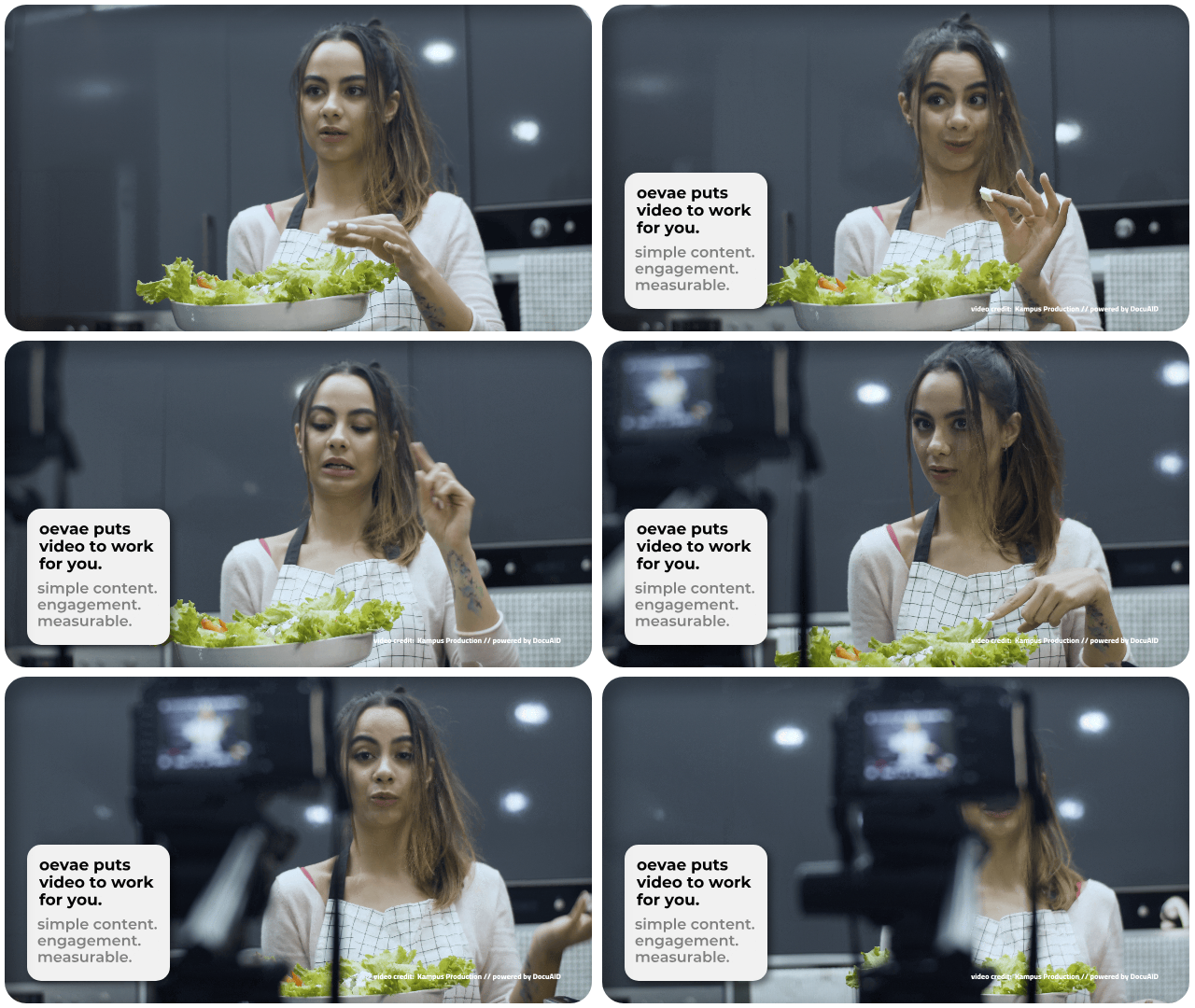
Video marketing is using video to attract, educate, and convert customers across the places people already spend time. That can include short social clips, website explainers, email videos, customer stories, and simple ads that answer common questions. It works well when attention is scarce because video communicates value quickly and builds familiarity.

It matters because video can improve ROI by turning one piece of content into many touchpoints across channels. It also supports customer acquisition by helping strangers feel like they know you before they visit or buy. Since 92.3% of internet users watch videos weekly, your message can meet them where they already are.

Think of a video like a helpful staff member who never clocks out. A 30-second “how it works” clip can reduce hesitation, while a behind-the-scenes story makes your brand feel human. That mix of clarity and storytelling is why businesses leveraging video keep growing. Stronger business fundamentals help you plan videos with clearer goals, tighter budgets, and more confident, data-backed decisions.

Strengthen Your Marketing Skills With Business Fundamentals

Once you understand why video marketing works, your next advantage is making stronger business decisions behind every campaign. Going back to school for a business degree can sharpen your marketing skills by strengthening the fundamentals that support planning, budgeting, and confident decision-making. By earning a degree focused on marketing, you can learn skills that can help your business thrive, so your video ideas are backed by clearer strategy instead of guesswork. Online degree programs also make it easier to keep running your business while you go to school at the same time; there’s additional information here to help you explore what that kind of program looks like.

Video Formats Compared by Goal

When you know the outcome you want, picking a video format gets much simpler. Use the table below to match common video types to the goal they serve best, plus the tradeoffs to plan for.

Option Benefit Best For Consideration
Live videos Builds real-time trust and interaction Q&A, launches, behind-the-scenes Needs confident delivery and moderating comments
Explainer videos Clarifies a complex offer quickly New services, landing pages, ads Requires tight scripting and clear visuals
Demo videos Shows how a product works Ecommerce, software, booking process Can date quickly as features change
Customer testimonials Adds social proof and credibility Higher-priced services, proposals Needs willing customers and release permissions
How-to videos Solves problems and supports SEO FAQs, onboarding, troubleshooting Requires consistency to build momentum

If you need ongoing visibility, it helps to know that educational videos are a format many teams keep investing in, which aligns well with how-to content. If your priority is faster conversion, demos and testimonials tend to answer purchase objections most directly. Knowing which option fits best makes your next move clear.

Video Marketing Questions Small Businesses Ask

Q: How much should I budget for video marketing when I’m just starting?
A: Start small and steady: set aside a monthly amount you can sustain for 90 days, even if it is just for one short video a week. Use your goal to guide spending, then reinvest only after you see traction. Many teams stick with video because it can pay off, and 87% of marketers report good ROI from video.

Q: How do I figure out my target audience for a video?
A: Pick one customer type and one problem per video. Use your top five customer questions, reviews, and sales calls to choose the topic and the exact words people use. Then write a simple promise: “This video helps you ____ without ____.”

Q: What tools do I need to produce decent videos without hiring an agency?
A: A smartphone, a $20 lav mic, a small tripod, and good window light can look surprisingly professional. Keep editing simple with templates, captions, and a consistent intro, then upgrade gear only when your process is repeatable.

Q: Which platforms should I publish on first?
A: Choose one “home base” where your audience already searches, then repurpose short clips for social. 93% of businesses use video as a marketing tool, so you do not need to be everywhere, just consistently present.

Q: How do I optimize video SEO with titles, keywords, hashtags, and descriptions?
A: Lead your title with the exact question you are answering and add a clear outcome. Put the main keyword in the first two lines of the description, include 3 to 5 specific hashtags, and add a simple call to action with one link.

Q: What metrics should I track to know if my videos are working?
A: Track watch time and retention to judge content quality, then clicks, leads, and sales to judge business impact. Pick one primary metric per goal, then compare results across videos in the same format.

Small Businesses Habits for Video Content Engagement

It’s easy to stall on video because budgets feel tight, tools feel confusing, and you don’t want to post something that falls flat. The steady path is a simple video marketing strategy: start small, stay consistent, and let real feedback guide video content creation, customer engagement tactics, and digital marketing integration over time. Done this way, marketing success becomes measurable and repeatable, more clarity on what resonates, stronger trust, and momentum that supports small business growth. Progress beats perfection in video marketing, so record and publish one short video this week, then review the results and make one improvement next time. That habit builds the visibility and connection that keep your business resilient as markets shift.


Tuesday, August 25, 2026

Maximize the Benefits of Change: Mobility35 Small Business Roadmap

Construction. Traffic. Road Closed.

How Smart Businesses can Redirect Opportunity and Maximize the Benefits of Change During Mobility35 and I-35 Construction
Mobility35 and I-35 construction small business opportunity in Austin Texas
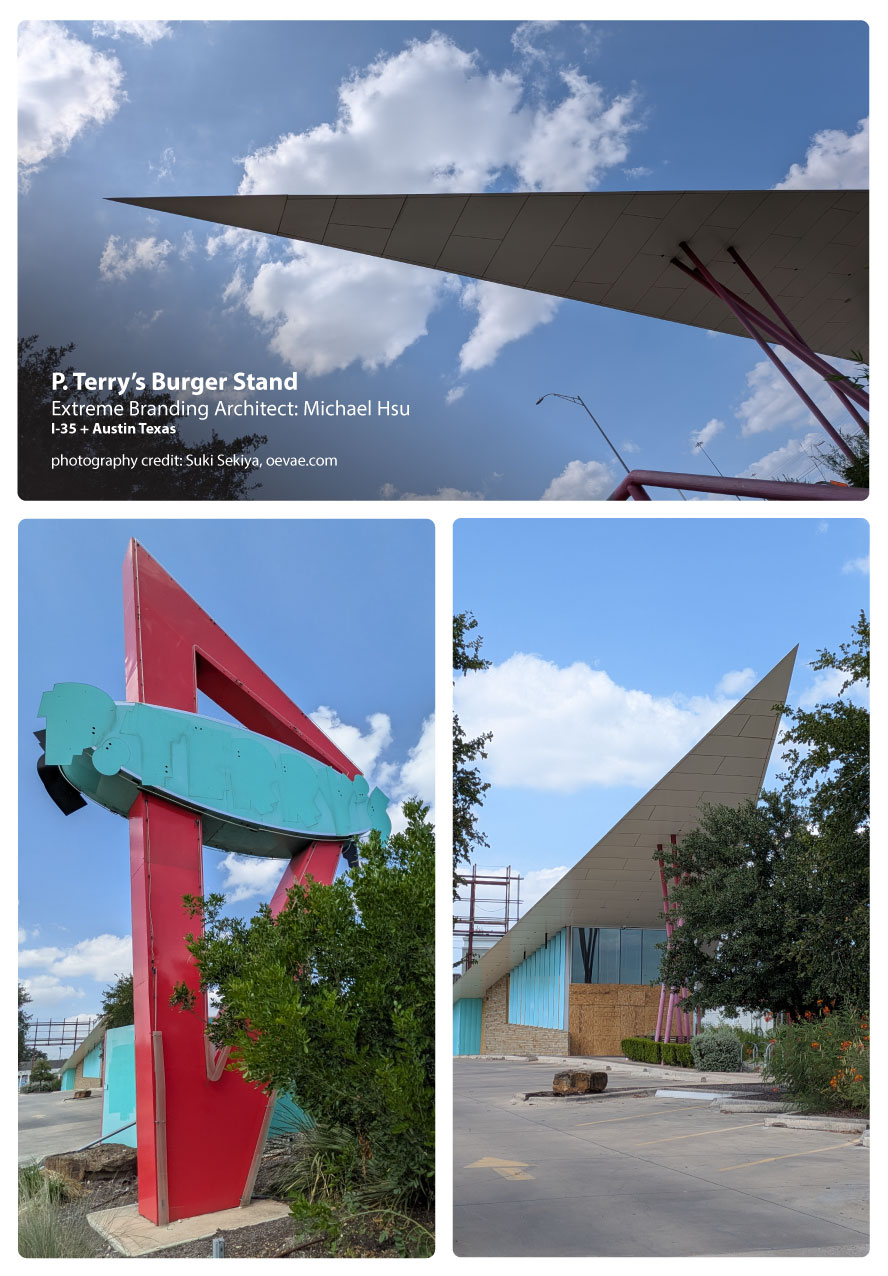
10 years ago (August 24, 2016), P. Terry's Burger Stand opened a flagship restaurant at Capital Plaza beside I-35. The building was created to be noticed. Its dramatic, futuristic Michael Hsu roofline reached toward the highway and turned architecture into advertising.

Today, ten years later, that building is gone — not because the burgers stopped selling or the brand stopped growing, but because the environment around the business changed. And perhaps, one of the clearest lessons a small-business owner can take from the enormous transformation underway along I-35. A smart strategy can be right for years and still have to change when the world around it changes.

P. Terry's had done many of the things businesses are told to do. It chose a high-traffic location, aligned itself with a major transportation corridor, invested in memorable design and deliberately chose Extreme Branding so the building itself communicated before a passing driver ever read the restaurant's name.

The strategy worked. The restaurant became a landmark. Then the artery changed.

“It just became a billboard for us for the last 10 years.” P. Terry's co-founder Patrick Terry, discussing the Capital Plaza flagship.

Change Doesn't Ask Permission From the Business Plan

For businesses around Rundberg Lane, Braker Lane and the surrounding North Austin corridor, the problem is usually less dramatic than losing an entire building, but the principle is the same. Mobility35 construction is changing the physical environment customers learned to navigate.

An entrance moves. A ramp closes. Construction barrels obscure a driveway. A familiar turn becomes inconvenient. A five-minute lunch trip can become a twenty-minute nuisance.

The business can be fully open and ready to serve while appearing, from the driver's perspective, difficult to reach.

That makes this a communication problem before it becomes a marketing problem.

TxDOT has to explain how motorists move through a massive transportation project. The business owner has a simpler responsibility: tell the customer how to get to the front door today.

Customer Road Map

Here's the idea behind a Customer Road Map. Instead of asking customers to interpret a construction diagram, give them the pieces of information they actually need: the best exit, the available entrance, where to park and whether another route will save time.

A QR code connected to a Mini Link can make that information flexible. The same code printed on a window, receipt, menu or temporary sign can point to the best route today and a different route next week. The physical communication stays in place while the information behind it changes.

That is why a QR Code Machine and Mini Link make sense in a construction environment. They are not interesting because they are technology. They are useful because they allow communication to move when the road moves.

Businesses should also keep up with current Mobility35 information rather than waiting for customers to explain the latest closure. TxDOT's Mobility35 site provides current project information, while businesses can also sign up for Mobility35 email updates.

Traffic Doesn't Disappear. It Goes Somewhere.

There is another side to construction that receives considerably less attention.

When a customer decides a familiar restaurant is suddenly too difficult to reach, that person usually does not stop eating lunch. They choose another restaurant.

When an exit becomes inconvenient, the business before the exit may suddenly become more attractive than the business after it. One company loses spontaneous traffic. Another gains it.

So while one owner is asking, “How do I keep my customers coming?”, another small-business owner may be looking at an unexpected increase in traffic and asking, “How do I keep these new people after the construction is over?”

Imagine someone walking into a restaurant and saying, “I normally go farther down the road, but I'm not fighting that construction today.”

The road has just introduced that business to somebody else's customer.

Now the business has to earn the second visit.

Maybe the food is better than expected. Maybe the service is faster. Maybe the customer likes the atmosphere or discovers a lunch special or menu item they never knew existed. They may have arrived because of a detour and return two weeks later because they found something worth returning to.

Construction may create the first visit. The experience creates the second.

That is why temporary traffic should not automatically be treated as temporary business.

Give People Something Worth Traveling For

Directions solve one form of friction. They do not solve the entire decision.

A customer deciding whether to make an inconvenient trip may also want to know what is on the menu, what it costs, what the food looks like and what kind of experience is waiting at the other end.

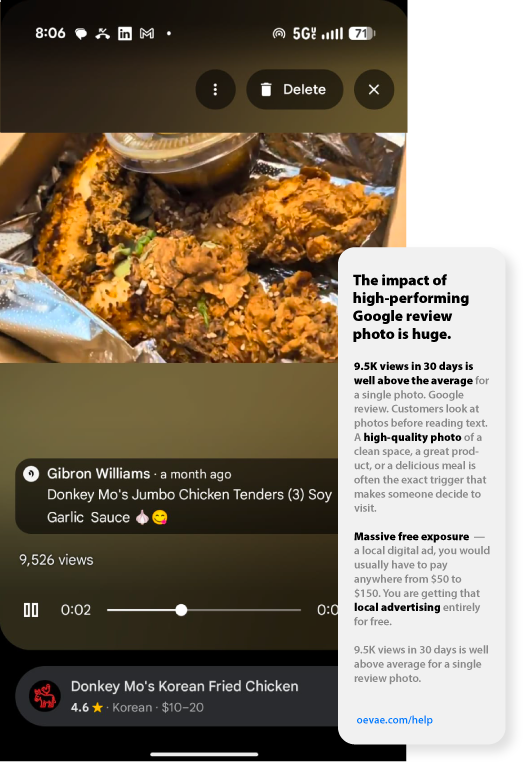
Real-world examples show how much attention practical and visual information can attract. A CVS photography service menu photograph accumulated 7,963 views. Vaqueros BBQ food truck menu reached 11,661. The Asian Mint reached 35,205 views for a dining area photograph. One restaurants Google Review photograph of the ABC Burger at Wizards Sports Café accumulated 418,206 views, while a six-second Donkey Mo's food Google Review video passes 10,000 views.

Those numbers do not mean every photograph will perform the same way. They demonstrate something more useful: customers consume information visually, and useful or appetizing information can keep working long after it is posted.

The service-menu photograph answers a practical question. The food-truck menu lets somebody make a buying decision before arriving. The restaurant interior sells atmosphere. The food image sells appetite. And six seconds of movement can sometimes communicate more effectively than an elaborate commercial.

Google can provide reach. Your brand should provide the experience.

Google Search, Maps, photographs, video and reviews can introduce somebody to a business. But all of that happens inside Google's environment.

A restaurant's own digital menu or Digital Flipbook can continue the experience with food photography, short video, prices, specials, directions, parking instructions, construction access information and the business's own visual identity.

The goal is not to replace Google. It is to let Google make the introduction while giving the business somewhere of its own to continue the conversation.

A New Guest Can Leave a Longer Digital Trail Than the Visit

More guests can also create more digital exposure.

This is not about pestering every customer for another review. It is about benefiting from the photographs, videos, reviews and detailed experiences people naturally share when something is worth documenting.

A customer visits because the normal route to another restaurant was inconvenient. They try something new. Maybe they take a photograph. Maybe they write about the experience. The business responds.

The meal ends. The digital interaction does not. One review-related image at Donkey Mo's Korean Fried Chicken approached 10,000 views in roughly 30 days.

Donkey Mo's Korean Fried Chicken 9K Google Local Guide Google Review image views

Somebody else can discover that contribution tomorrow. Another customer can read it next month. A thoughtful business response remains visible to future customers who were never part of the original transaction.

That is how temporary traffic can begin producing a longer digital tail.

If a business wants to make returning easier, a QR code, Mini Link, branded Digital Flipbook or Lead Capture experience can provide a simple next step. Not because everybody needs to enter a marketing funnel, but because returning should be easier than rediscovering.

The Difference Between a Location and a Business

That brings us back to P. Terry's Burger Stand – The Capital Plaza building mattered precisely because it was not generic. P. Terry's deliberately chose Extreme Branding. Michael Hsu's futuristic roofline, color, geometry and relationship to I-35 were intentional. The building itself became part of the message.

The highway changed. Building demolished. Landmark disappeared.
The brand did not.

Extreme Branding made the location memorable. Change made the location temporary.
P-Terry's #11 Capital Plaza, Austin, Texas Demolition

Adaptability allows the business to continue.

Small businesses have lived through enough disruption to recognize the larger pattern. COVID accelerated curbside pickup, delivery, digital ordering and contactless transactions. Other major events changed how businesses think about security and access. Technology continually changes how customers discover, evaluate and buy.

Mobility35 is changing something more physical: how people move through Austin.

The disruption itself is not necessarily the opportunity. The response can be.

How Small Businesses Can Maximize the Benefits of Change

For one business, adapting may mean giving regular customers a clearer route to the parking lot. For another, it may mean recognizing that unfamiliar customers are walking through the door because somebody else's route became inconvenient.

Another business may discover that its menu deserves to be easier to find, that a six-second video can communicate appetite, or that Google's reach becomes more valuable when it leads into a branded experience the business controls.

The larger lesson is not to fear change or pretend every disruption is good. It is to avoid confusing a successful strategy with a permanent environment.

P. Terry's had the traffic, the product, the brand, the location and the extraordinary building.

The environment still changed.

That is not an argument against long-range planning. It is an argument for putting adaptability inside the plan.

Useful business information should reaffirm what owners already know, confirm what they suspect, establish something they did not know and help them benefit from something they did not know was available to them.

Ten years ago, a futuristic roof pointed into the Austin sky beside I-35.

Today, the building is gone. The company continues. The highway continues. Austin continues.

Traffic moves.

Opportunity moves with it.

Construction redirects traffic.
Smart businesses redirect opportunity.
Weird for some, but that's Austin, Texas.

Friday, August 21, 2026

FREE Is Valuable: How Smart Freebies Turn Strangers Into Customers

Create Massive Engagement - Everyone Likes a Freebie

Free does not mean worthless. Sometimes, something as simple as a free sample, a free meal, a free trial or a useful digital tool can remove the hesitation standing between curiosity and becoming a customer. From AOL putting trial discs into millions of homes to KFC creating lines for free chicken, Dropbox rewarding referrals and Spotify letting people listen before they subscribe, some of the world’s largest brands have used “free” as the beginning of a relationship—not the end of a sale.

For a small business owner, the word free can sound dangerous.

Free costs money. Free takes time. Free can attract people who never intend to buy anything.

All true.

But when the free offer is connected directly to the value of the product or service, it can do something advertising alone cannot:

It lets the customer experience the answer before asking them to believe the promise.

AOL Put the Internet in the Mailbox

Before internet access was ordinary, AOL had a problem: people could not fully understand the value of getting online until they actually got online.

So AOL gave them the opportunity to try it.

Its aggressive direct-mail campaign sent free-trial floppy disks and CDs to millions of households. The Smithsonian reports that more than 10% of recipients of AOL’s first major mailing signed up, and AOL eventually spent hundreds of millions of dollars expanding the strategy. Former AOL marketing chief Jan Brandt later said the company was registering a new subscriber about every six seconds at the campaign’s height.

By the end of 2001, AOL reported 25.2 million domestic members.

The disc wasn’t really the product.

The experience was the product.

Sources: Smithsonian · SEC filing

KFC: When “Free” Works Too Well

KFC provides another powerful lesson in freebie marketing—including what can happen when demand outruns the plan.

In 2009, KFC partnered with Oprah Winfrey to offer a downloadable coupon for a free grilled chicken meal. The response was enormous. More than 10 million coupons were reportedly downloaded, restaurants were overwhelmed, some locations ran short of product, and KFC ultimately moved customers to a rain-check system.

The promotion proved that “free” could create massive engagement—but it also showed why fulfillment, limits and capacity have to be part of the strategy.

KFC approached the idea much differently in 2025 with its “Free Bucket On Us” comeback campaign. Customers could receive a free eight-piece bucket of chicken or tenders with a $15+ online purchase through KFC.com or the KFC app. The offer required a KFC Rewards account and was limited to one redemption per account.

Same powerful word: FREE. Better controls.

That evolution matters for small businesses. The objective is not simply to generate the biggest response possible. It is to create an offer that attracts attention and can be fulfilled profitably without overwhelming the business.

Sources: The Hollywood Reporter · KFC

Companies That Used Direct Mail, Trials or Free Offers to Acquire Customers

  • CompuServe: AOL’s primary competitor in the early 1990s also distributed trial software to introduce consumers to online services.
  • Prodigy: Used trial access and promotional software while competing for early dial-up customers.
  • EarthLink: Distributed installation software and promotional access offers as internet adoption expanded.
  • JDate: Used trial-oriented customer acquisition to reduce the barrier to testing online dating.
  • ButcherBox: Uses free product add-ons, including meat offers tied to qualifying subscriptions, to encourage new customers to try the service.
  • HelloFresh: Regularly introduces customers through discounted or free first-box promotions.

The tactic did not disappear when floppy disks disappeared.

It simply changed form.

Physical “Freebie” Campaigns

Companies have also used samples to let the product make its own argument:

  • KFC: Used free food offers to generate enormous trial and engagement—from the overwhelming 2009 Oprah grilled-chicken giveaway to the more controlled 2025 “Free Bucket On Us” digital promotion.
  • Country Time Lemonade: Lemonade samples and promotional kits encouraged trial.
  • Folgers Coffee: Single-use coffee samples gave consumers a low-risk reason to consider switching brands.
  • Tide: Single-load detergent samples let performance become part of the sales pitch.
  • Colgate and Crest: Travel-size toothpaste samples introduced households to products designed around repeat purchasing.
  • Splenda: Sample packets allowed consumers to test the taste before buying a larger package.
  • KIND Bars: Sampling placed the actual product into consumers’ hands rather than merely telling them what it tasted like.

The common denominator? Reduce the distance between hearing about the product and experiencing the product.

Free Went Digital

Today’s equivalent might cost almost nothing to distribute.

Instead of mailing a sample, businesses can offer access, storage, functionality, education, a limited service, a demonstration or a useful tool.

Digital Freemium and Free-Trial Growth

  • Dropbox: Gives users additional free storage for successful referrals. Dropbox Basic users can earn up to 16 GB through referrals, creating a built-in incentive for customers to introduce other customers.
  • Spotify: Offers useful ad-supported access instead of requiring payment before someone experiences the service. Spotify has said more than 60% of Premium subscribers previously used the free tier.
  • Adobe: Uses full-feature trials to let customers experience professional software before committing to an ongoing subscription.
  • Duolingo: Keeps its core learning experience accessible without a hard paywall, using the free product to build enormous reach before monetizing through subscriptions, ads and other upgrades.
  • Canva: Offers a substantial free design platform while reserving additional tools, brand features and assets for paid plans.
  • Zoom: Its accessible free tier lowered the friction of inviting someone else to a meeting and helped turn user-to-user invitations into distribution.
  • HubSpot: Built an entry point around free CRM tools, allowing businesses to begin managing customer relationships before needing more sophisticated paid marketing and sales products.

Additional sources: Dropbox (Install app, earn 500 MB) · Spotify · Duolingo · Canva

Notice What These Companies Did Not Do

They did not simply yell:

FREE! FREE! FREE! No, it doesn't. Their FREE offer performed a job.

Dropbox gave you storage.

Spotify gave you music.

Canva let you design.

Duolingo let you learn.

HubSpot let you organize customer relationships.

AOL let you experience the internet.

KFC let customers taste the promotion itself.

That distinction matters.

What Could Your Small Business Give Away?

It does not necessarily need to be merchandise.

A useful free offer could be:

  • a sample
  • a consultation
  • a limited trial
  • a downloadable guide
  • a small tool
  • a diagnostic
  • a template
  • a demonstration
  • a complimentary upgrade
  • limited access to a larger service
  • a useful piece of information people would otherwise spend time finding themselves

The goal isn’t to give away the store.

The goal is to give someone enough evidence to confidently take the next step.

Don’t Risk It All to Find Out

This is also where small businesses can get into trouble.

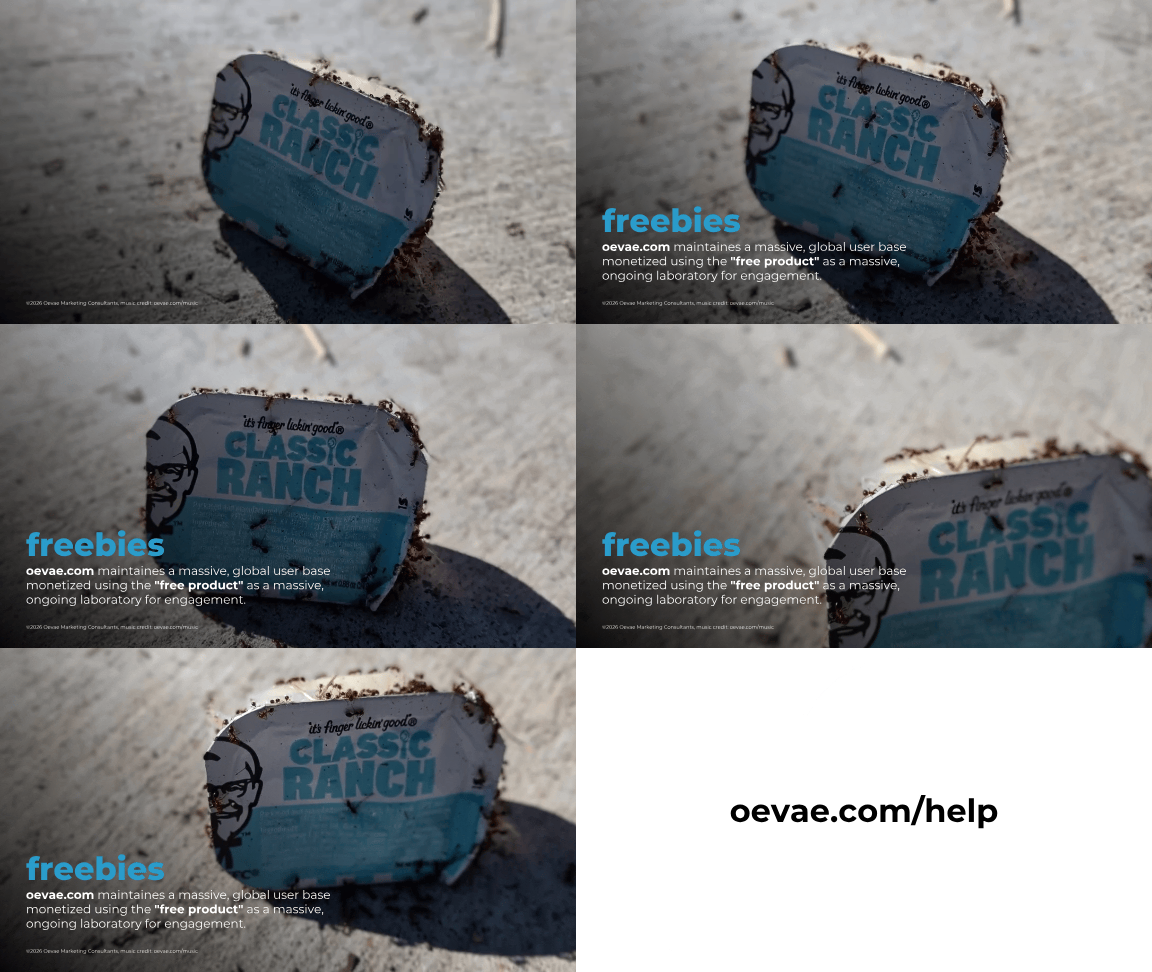
A clever idea isn’t automatically a good business decision. If you are old enough to remember the food court in a shopping mall, the restaurants would give out free food samples – a classic sensory marketing tactic. It uses the power of smell, taste, and instant gratification to break down consumer resistance, turning casual walkers into paying customers. Samples remove the risk (Overcoming Hesitation) of trying an unfamiliar dish, especially at fast-casual Asian or specialty eateries. And, tetting something for free creates a subtle psychological urge (The Rule of Reciprocating) to return the favor by buying a full meal.

At Oevae Marketing Consultants, we can help a business approach an idea in three steps:

  • Identify what could genuinely create value or remove hesitation for your prospective customer.
  • Eliminate ideas that are too expensive, attract the wrong audience, create fulfillment problems or don’t lead naturally toward the paid product.
  • Confirm the strongest direction through a controlled test before committing significant time, money or resources.

You don’t need to know with absolute certainty that an idea will work.

You need a way to learn without risking it all.

“Sometimes, all you need is a little help.” — Gibrón Williams

And very soon, we’re going to practice a little of what we’re talking about here with something new we’ve been building around Móneta World.

But that’s another conversation.

For now, ask yourself one question:

What could you let a prospective customer experience today that would make tomorrow’s buying decision easier?

Make a brand difference.™