
Showing posts with label Google reviews. Show all posts

Tuesday, August 25, 2026

Maximize the Benefits of Change: Mobility35 Small Business Roadmap

Construction. Traffic. Road Closed.
How Smart Businesses can Redirect Opportunity and Maximize the Benefits of Change During Mobility35 and I-35 Construction
Mobility35 and I-35 construction small business opportunity in Austin Texas
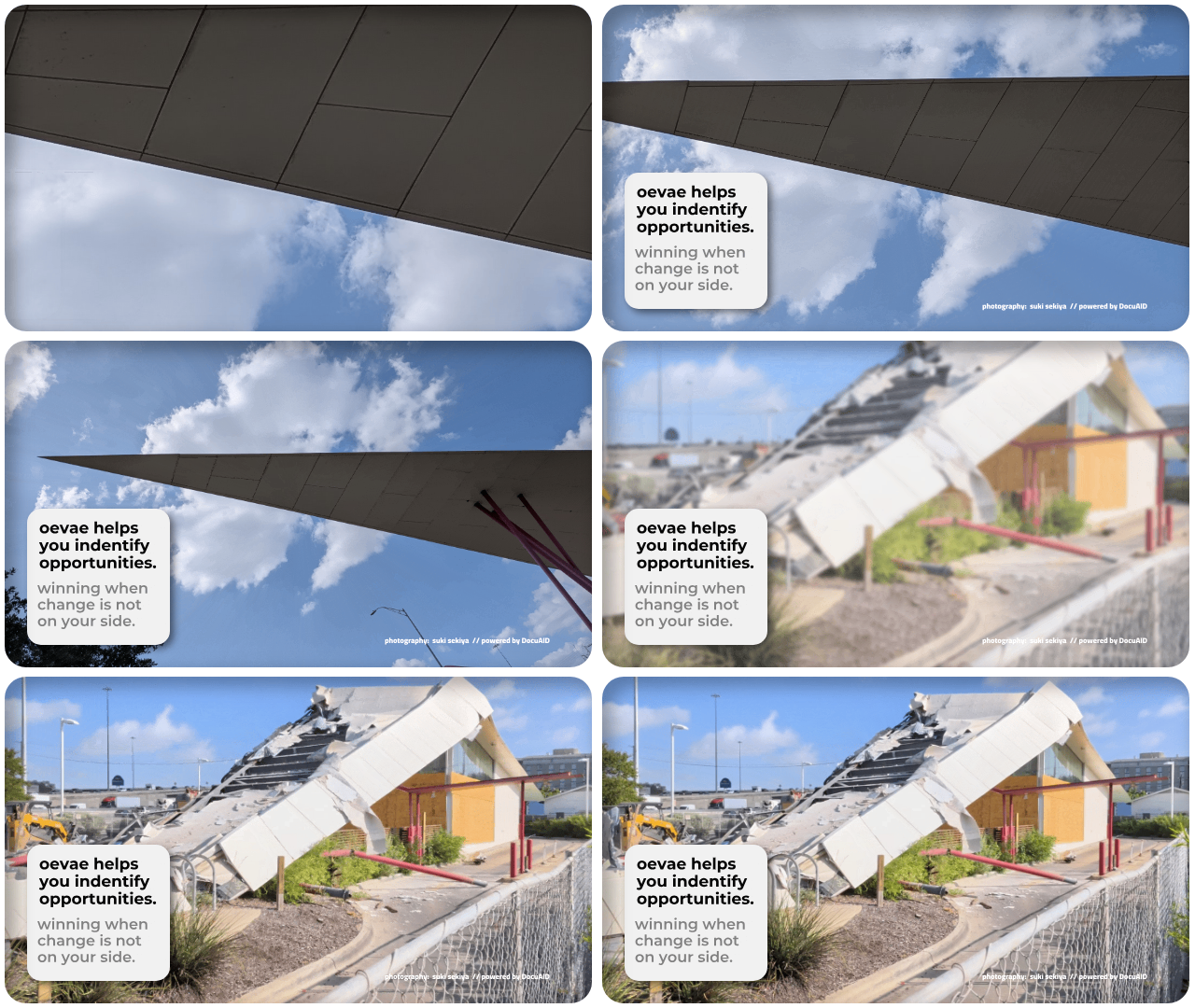
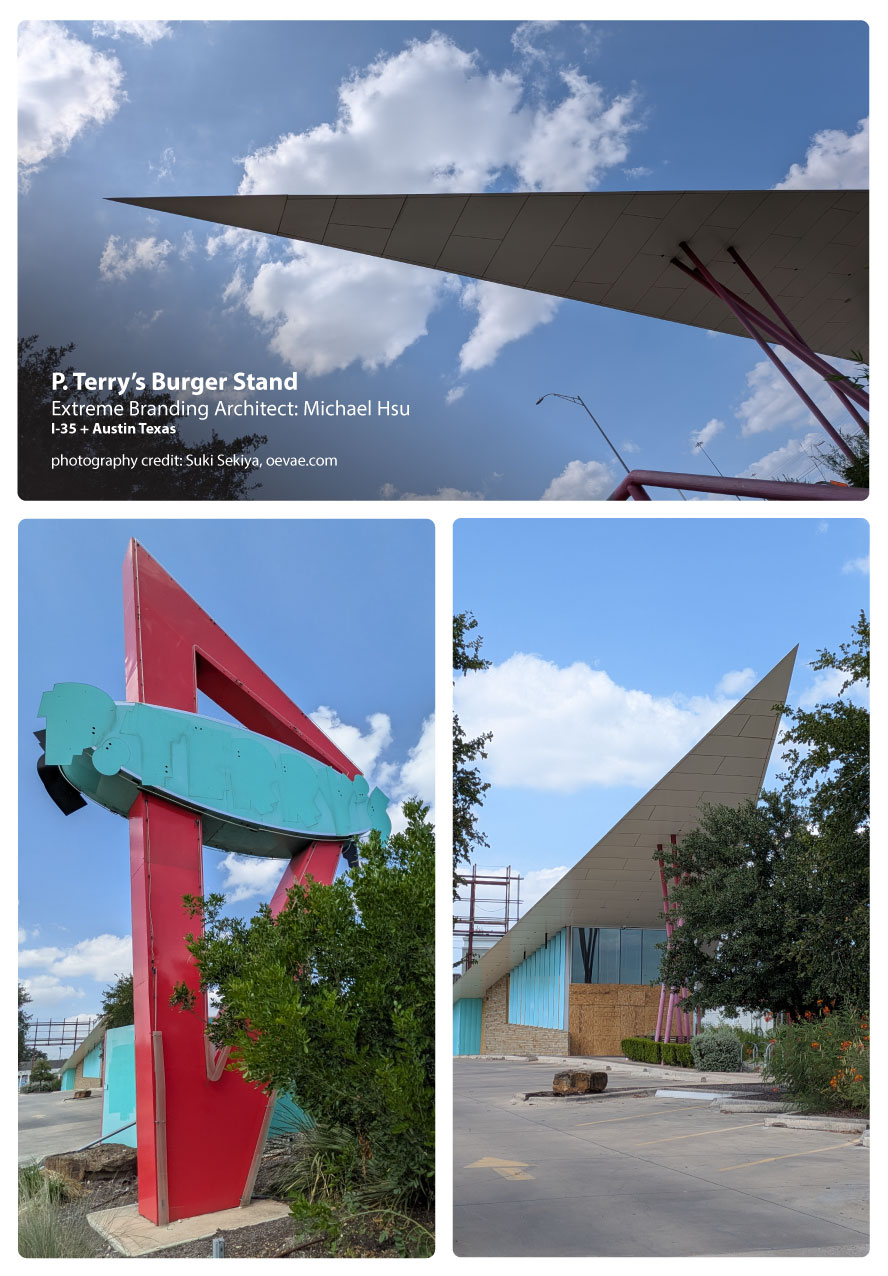
10 years ago (August 24, 2016), P. Terry's Burger Stand opened a flagship restaurant at Capital Plaza beside I-35. The building was created to be noticed. Its dramatic, futuristic Michael Hsu roofline reached toward the highway and turned architecture into advertising.

Today, ten years later, that building is gone — not because the burgers stopped selling or the brand stopped growing, but because the environment around the business changed. And perhaps, one of the clearest lessons a small-business owner can take from the enormous transformation underway along I-35. A smart strategy can be right for years and still have to change when the world around it changes.

P. Terry's had done many of the things businesses are told to do. It chose a high-traffic location, aligned itself with a major transportation corridor, invested in memorable design and deliberately chose Extreme Branding so the building itself communicated before a passing driver ever read the restaurant's name.

The strategy worked. The restaurant became a landmark. Then the artery changed.

“It just became a billboard for us for the last 10 years.” P. Terry's co-founder Patrick Terry, discussing the Capital Plaza flagship.

Change Doesn't Ask Permission From the Business Plan

For businesses around Rundberg Lane, Braker Lane and the surrounding North Austin corridor, the problem is usually less dramatic than losing an entire building, but the principle is the same. Mobility35 construction is changing the physical environment customers learned to navigate.

An entrance moves. A ramp closes. Construction barrels obscure a driveway. A familiar turn becomes inconvenient. A five-minute lunch trip can become a twenty-minute nuisance.

The business can be fully open and ready to serve while appearing, from the driver's perspective, difficult to reach.

That makes this a communication problem before it becomes a marketing problem.

TxDOT has to explain how motorists move through a massive transportation project. The business owner has a simpler responsibility: tell the customer how to get to the front door today.

Customer Road Map

Here's the idea behind a Customer Road Map. Instead of asking customers to interpret a construction diagram, give them the pieces of information they actually need: the best exit, the available entrance, where to park and whether another route will save time.

A QR code connected to a Mini Link can make that information flexible. The same code printed on a window, receipt, menu or temporary sign can point to the best route today and a different route next week. The physical communication stays in place while the information behind it changes.

That is why a QR Code Machine and Mini Link make sense in a construction environment. They are not interesting because they are technology. They are useful because they allow communication to move when the road moves.

Businesses should also keep up with current Mobility35 information rather than waiting for customers to explain the latest closure. TxDOT's Mobility35 site provides current project information, while businesses can also sign up for Mobility35 email updates.

Traffic Doesn't Disappear. It Goes Somewhere.

There is another side to construction that receives considerably less attention.

When a customer decides a familiar restaurant is suddenly too difficult to reach, that person usually does not stop eating lunch. They choose another restaurant.

When an exit becomes inconvenient, the business before the exit may suddenly become more attractive than the business after it. One company loses spontaneous traffic. Another gains it.

So while one owner is asking, “How do I keep my customers coming?”, another small-business owner may be looking at an unexpected increase in traffic and asking, “How do I keep these new people after the construction is over?”

Imagine someone walking into a restaurant and saying, “I normally go farther down the road, but I'm not fighting that construction today.”

The road has just introduced that business to somebody else's customer.

Now the business has to earn the second visit.

Maybe the food is better than expected. Maybe the service is faster. Maybe the customer likes the atmosphere or discovers a lunch special or menu item they never knew existed. They may have arrived because of a detour and return two weeks later because they found something worth returning to.

Construction may create the first visit. The experience creates the second.

That is why temporary traffic should not automatically be treated as temporary business.

Give People Something Worth Traveling For

Directions solve one form of friction. They do not solve the entire decision.

A customer deciding whether to make an inconvenient trip may also want to know what is on the menu, what it costs, what the food looks like and what kind of experience is waiting at the other end.

Real-world examples show how much attention practical and visual information can attract. A CVS photography service menu photograph accumulated 7,963 views. Vaqueros BBQ food truck menu reached 11,661. The Asian Mint reached 35,205 views for a dining area photograph. One restaurants Google Review photograph of the ABC Burger at Wizards Sports Café accumulated 418,206 views, while a six-second Donkey Mo's food Google Review video passes 10,000 views.

Those numbers do not mean every photograph will perform the same way. They demonstrate something more useful: customers consume information visually, and useful or appetizing information can keep working long after it is posted.

The service-menu photograph answers a practical question. The food-truck menu lets somebody make a buying decision before arriving. The restaurant interior sells atmosphere. The food image sells appetite. And six seconds of movement can sometimes communicate more effectively than an elaborate commercial.

Google can provide reach. Your brand should provide the experience.

Google Search, Maps, photographs, video and reviews can introduce somebody to a business. But all of that happens inside Google's environment.

A restaurant's own digital menu or Digital Flipbook can continue the experience with food photography, short video, prices, specials, directions, parking instructions, construction access information and the business's own visual identity.

The goal is not to replace Google. It is to let Google make the introduction while giving the business somewhere of its own to continue the conversation.

A New Guest Can Leave a Longer Digital Trail Than the Visit

More guests can also create more digital exposure.

This is not about pestering every customer for another review. It is about benefiting from the photographs, videos, reviews and detailed experiences people naturally share when something is worth documenting.

A customer visits because the normal route to another restaurant was inconvenient. They try something new. Maybe they take a photograph. Maybe they write about the experience. The business responds.

The meal ends. The digital interaction does not. One review-related image at Donkey Mo's Korean Fried Chicken approached 10,000 views in roughly 30 days.
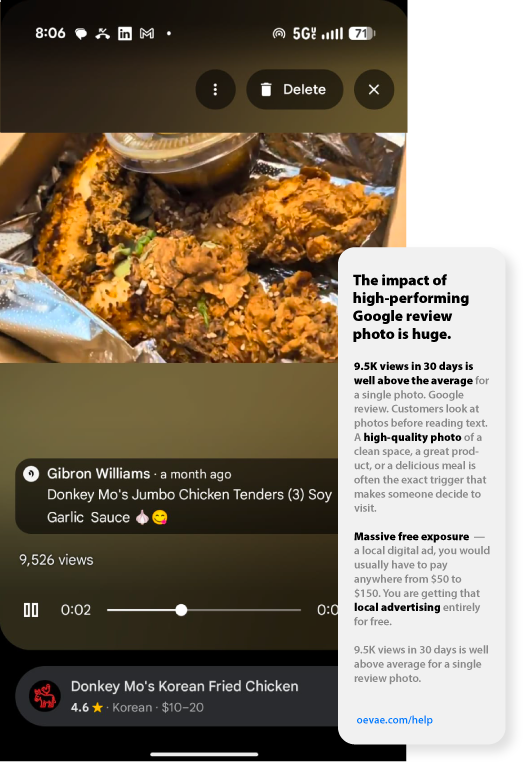
Donkey Mo's Korean Fried Chicken 9K Google Local Guide Google Review image views

Somebody else can discover that contribution tomorrow. Another customer can read it next month. A thoughtful business response remains visible to future customers who were never part of the original transaction.

That is how temporary traffic can begin producing a longer digital tail.

If a business wants to make returning easier, a QR code, Mini Link, branded Digital Flipbook or Lead Capture experience can provide a simple next step. Not because everybody needs to enter a marketing funnel, but because returning should be easier than rediscovering.

The Difference Between a Location and a Business

That brings us back to P. Terry's Burger Stand – The Capital Plaza building mattered precisely because it was not generic. P. Terry's deliberately chose Extreme Branding. Michael Hsu's futuristic roofline, color, geometry and relationship to I-35 were intentional. The building itself became part of the message.

The highway changed. Building demolished. Landmark disappeared.
The brand did not.
Extreme Branding made the location memorable. Change made the location temporary.
P-Terry's #11 Capital Plaza, Austin, Texas Demolition

Adaptability allows the business to continue.

Small businesses have lived through enough disruption to recognize the larger pattern. COVID accelerated curbside pickup, delivery, digital ordering and contactless transactions. Other major events changed how businesses think about security and access. Technology continually changes how customers discover, evaluate and buy.

Mobility35 is changing something more physical: how people move through Austin.

The disruption itself is not necessarily the opportunity. The response can be.

How Small Businesses Can Maximize the Benefits of Change

For one business, adapting may mean giving regular customers a clearer route to the parking lot. For another, it may mean recognizing that unfamiliar customers are walking through the door because somebody else's route became inconvenient.

Another business may discover that its menu deserves to be easier to find, that a six-second video can communicate appetite, or that Google's reach becomes more valuable when it leads into a branded experience the business controls.

The larger lesson is not to fear change or pretend every disruption is good. It is to avoid confusing a successful strategy with a permanent environment.

P. Terry's had the traffic, the product, the brand, the location and the extraordinary building.

The environment still changed.

That is not an argument against long-range planning. It is an argument for putting adaptability inside the plan.

Useful business information should reaffirm what owners already know, confirm what they suspect, establish something they did not know and help them benefit from something they did not know was available to them.

Ten years ago, a futuristic roof pointed into the Austin sky beside I-35.

Today, the building is gone. The company continues. The highway continues. Austin continues.

Traffic moves.

Opportunity moves with it.

Construction redirects traffic.
Smart businesses redirect opportunity.
Weird for some, but that's Austin, Texas.

Monday, June 8, 2026

Why Google Review Replies Still Matter for Local SEO


Small business owners often ask a very good question:

Does replying to Google reviews still help with local SEO, or is that not as important as it used to be?

The short answer is yes, replying to Google reviews still matters. But the smarter answer is that review replies are only one part of a larger local visibility and reputation strategy.

A Google review reply will not magically move a business to the top of Google Maps by itself. However, consistent, thoughtful responses can help show that the business is active, engaged, trustworthy, and paying attention to its customers. That matters because people are not only reading the reviews. They are also watching how the business responds.

Why Google Review Replies Matter

When someone searches for a local business, they are often comparing several options at once. They may look at star ratings, review count, photos, services, location, hours, and how recently the business has been reviewed. But they may also check whether the business replies.

That reply can say a lot.

A professional response tells potential customers:

  • This business is active.
  • This business values customer feedback.
  • This business pays attention.
  • This business handles problems maturely.
  • This business is still operating and engaged.

That matters especially for service-based businesses, healthcare offices, contractors, restaurants, retail stores, consultants, salons, repair companies, and any business where trust plays a major role in the buying decision.

Photos in Reviews Boost Engagement

Photos in reviews boost engagement by signaling authenticity and trust, which encourages more users to click on your business profile. While not a direct ranking factor in Google’s core algorithm, this increased click-through rate (CTR) and dwell time serve as strong signals to Google that your business is relevant, indirectly improving local search visibility.

NoteIn Google Maps, an "a month ago" label represents a rolling 30 to 59-day window rather than a precise date, indicating feedback left roughly four to eight weeks prior. This categorization highlights recent customer activity, which is crucial for maintaining and boosting local search rankings for small businesses. For more details, visit Google Support.


H-E-B Google Review Featured Photo 50K Views


Key data highlights include:

  • Increased Engagement: Listings with high-quality visual content are 90% more likely to attract visits from online users and 42% more likely to receive requests for directions.
  • Consumer Trust: Customer-submitted photos are critical decision-making factors for industries like hospitality, food, and beauty, with many consumers stating they rely on these visuals to verify quality and atmosphere before visiting.
  • Visibility Priority: Google often prioritizes displaying reviews that include photos at the top of your review section, making them the first thing potential customers see.

Does Replying to Reviews Help Local SEO?

Review replies can support local SEO, but they should not be treated like a shortcut or trick.

Google’s local search system looks at major factors such as relevance, distance, and prominence. Reviews can contribute to prominence, especially when a business has strong ratings, steady review activity, and a credible reputation. Replying to reviews supports that bigger reputation picture.

The real value is not just “SEO.” The real value is conversion.

A business may already appear in search, but if its reviews are unanswered, negative comments are ignored, or every reply sounds robotic, potential customers may move on to a competitor. Local SEO gets the business seen. Reputation helps the customer choose.

Google's official support documentation does not specify a 24-48 hour deadline for replying to reviews, but instead advises that responding to customer feedback improves visibility and local ranking. The "as soon as possible" standard is an industry consensus based on maximizing customer engagement, rather than a direct guideline from Google. For more details, visit Google Business Profile Help.

Why Review Replies Are Even More Important Now

Today, people are more cautious. They compare businesses quickly. They scan reviews. They look for signs of honesty. They want to know how a business treats real customers.

With AI summaries, Google Business Profiles, map results, mobile search, and voice search all shaping how people discover local businesses, review content is becoming part of the larger story search engines and customers use to understand a company.

"That does not mean arguing online. It means showing professionalism." 

– GibrĂłn Williams, Oevae Marketing Consultants

If a negative review is left unanswered, that one-sided story may sit there for months or years. But if the business responds calmly and factually, it gives future customers more context.

Customer-to-Customer Engagement Matters Too

Reviews are not only conversations between the customer and the business. Sometimes, they become customer-to-customer signals.

For example, imagine a customer sitting in a local pizza restaurant, enjoying her meal, taking a photo, and leaving a positive review from her phone. Later, another customer sees that review and taps the heart or marks it as helpful because it helped them decide where to eat.

Small actions matter.

A heart, like, or helpful reaction does not mean Google is handing the business an automatic ranking boost. But it does suggest that real people found the review useful. That kind of engagement can strengthen the public value of the review because it shows that the content is not just sitting there — people are interacting with it.

For a small business, that is important because a strong review can keep working long after it was posted. One customer shares the experience. Another customer reacts to it. A future customer reads it. Then the business reply adds one more layer of trust.

That is how reviews become more than comments. They become part of the business’s public reputation.


How Small Businesses Should Reply to Google Reviews

The best review replies are simple, human, and specific.

Think about that same customer at a local pizza restaurant. She enjoyed her food, smiled at the experience, picked up her phone, and shared a positive review. That review is public engagement. Other people may see it later when deciding where to eat, what to order, or whether the business feels welcoming.

For a positive review, thank the customer and make the reply feel connected to the real experience.

Example:

“Thank you, Angela. We’re glad you enjoyed your pizza and appreciate you taking a moment to share your experience. It means a lot when customers help others discover our restaurant, and we hope to see you again soon.”

For a negative review, stay calm, avoid defensiveness, and offer a direct way to resolve the issue.

Example:

“Thank you for bringing this to our attention. We’re sorry your visit did not match the experience we want every guest to have. Please contact our team directly so we can better understand what happened and work toward making it right.”

The goal is not to win an argument. The goal is to show every future customer that the business listens and responds professionally.

What Not to Do When Replying to Reviews

Avoid copy-and-paste replies on every review. Avoid stuffing keywords into responses. Avoid blaming the customer. Avoid sharing private information. Avoid long emotional explanations. And never pay for fake reviews or ask people to leave dishonest feedback.

Review responses should sound like the business — not like a robot and not like a legal threat.

A Simple Review Response Workflow

A small business does not need a complicated system to start improving its review presence.

Start with this:

  1. Reply to new reviews within 24 to 72 hours when possible.
  2. Prioritize negative reviews and detailed reviews first.
  3. Use the customer’s name if appropriate.
  4. Mention the service or experience naturally.
  5. Keep the tone professional.
  6. Move serious issues offline.
  7. Review the pattern of feedback monthly.

Over time, those replies become part of the business’s public reputation.

The Bottom Line

Replying to Google reviews is still important for small businesses. It supports local SEO, but more importantly, it supports trust.

A review is not just feedback from one customer. It is public content that future customers may use to decide whether to call, click, visit, book, or buy.

When customers engage with reviews by liking them, reacting to them, or marking them as helpful, that review becomes even more valuable as social proof. When the business also responds, it completes the circle: customer experience, public feedback, customer engagement, and professional follow-up.

Small businesses that respond consistently are not just managing reviews. They are managing first impressions. 

Oevae helps small businesses turn customer feedback into better visibility, stronger trust, and smarter marketing. Get more help at oevae.com/help 


Wednesday, June 7, 2023

Small Business Help: Creative Branding with Creative Marketing

Carmine's Pizzeria Google Review Pepperoni and Sausage Pizza, fDallas, TX

Trying to craft marketing content that gets the attention of the people you want to be your customers can leave you scratching your head. You can seek advice from a friend in the marketing business or perhaps ask a close family member who knows someone who works in the marketing department of a Fortune 100 company who might give you some good suggestions. However, there's nothing like having the people on the front lines of marketing nearby to help with your business communications. Not doing so can lead to lost opportunities, miscommunications, and a really tough learning experience.


This post will help you with at least three things:

  • Identify missed opportunities to influence potential customers.
  • Find out what consumers are searching for Online
  • Leverage simple technologies that influence prospects


At Oevae, we solve the problems between "what you are thinking" about content marketing and "what it will take to make those thoughts a reality." Whether getting more customers, looking more like a real business, or simply changing your approach, we can help you find direction and solutions for growing your business by identifying gaps in your marketing, so you can squeeze more potential out of your brand.


Here are a few creative marketing ideas that might help your Brand become more attractive to the people you want to be your customers. You may have thought about it but don't have the tools or people around you to help you make it happen. Sometimes all you need is a little help.


1.  Identify missed opportunities to influence potential customers.


Email Signatures that include your logo help readers quickly differentiate your email from the previous email. Email Signatures give the recipient a lasting impression of whom they are doing business with, making your contact information easy to find whenever the email recipient wants to connect with you, and it serves as a nest for several ways to access information about your company, other than email.


81% of small businesses rely on email as their primary customer acquisition channel, and 80% for retention. 


– Oberlo (Shopify Inc. Multinational E-commerce Company}


Business Cards work harder for you than Near Field Communication (NFC), and here's why. Once you use NFC (holding your phone near the data source to share small payloads of data between, similar to contactless payments popularized by COVID-19) to add a new phone number to your smartphone contacts, it's quickly out-of-site and out-of-mind. Meanwhile, a business card is still working for you. The business card gives you another opportunity to reinforce your brand identity and adds to the number of impressions your logo hits the conscious mind of the recipient. The recipient of the business card must find a resting place, sometimes the trash, but sometimes they are stored in a stack on the desk, in a desk drawer, purse or backpack, or maybe in a wallet. 


The best part about using business cards is, every time a person with your business card looks at it, they will remember who or where they received it. The longer it takes someone with your business card to put it out of sight, the longer their exposure to your brand. A similar approach is used by Fortune 100 brands, placing their logo on togo cups and shopping bags because they know the life expectancy of that disposable item will soon resonate with your subconscious mind. For instance, some customers like round business cards because they can double as a beverage coaster.  We've designed other business cards with QR codes to direct prospects for customized experiences.


Google Reviews can dramatically increase the number of times prospects find your company online, especially those with photographs, because they are more personal and relatable, which helps the reader better visualize and understand a reviewer's experience, making it even more valuable and convincing than reviews without photographs. Remember this the next time you ask a customer for a Google Review. It gives potential shoppers a glimpse into the experience you provide. A study by Sterling Sky Inc found that having a photo had a massive impact on how long a review stayed at the top of the reviews list on Google.  In fact, the photograph Pepperoni and Sausage Pizza, from Carmine's Pizzeria in Dallas, TX used at the beginning of this blog post is from a Google Review published in May 2020 and currently has 42,565 views.  That's an average of over 1,100 non-paid views per month (1,182.3) benefiting Carmine's Pizzeria.


2. Find out what consumers are searching for Online


Google Trends is a very effective way to easily see what consumers are on the Internet searching for all around the world, right down to your state, city, demographic, and time of day.  Visualise, discover and compare trending topics and people's search behavior within Google Search, Google News, Google Images, Google Shopping, and YouTube. With this data, you can better craft your promotional headlines, website content and keywords, email marketing Subject lines, text messages, and even the hashtags used in social media posts. 


Google Analytics provides countless resources to understand user behavior on your website, where aggregating your most authentic content should be. Two of the most valuable aspects are your ability to improve search engine optimization, groom content, find your target audience, and reinforce positive beliefs about your brand. With a comprehensive understanding of how your people engage with your website in real-time and business, you can deliver better experiences that help you grow your customer base organically.


"Authenticity means being open to stories that normalize the experience customers have with a brand, which is sometimes critical. Create a personal connection and tailor the customer experience. Personalization can go a long way toward building trust." 


– Forbes Business Development Council


 3. Leverage simple technologies that influence prospects


URL shorteners with branding capabilities allow you to share branded links as part of automated workflows – with the name of your choosing, you can take total control of your content, and your audience will know they can trust recognizable links. "With trust comes action. Businesses that share custom links see a boost in click-throughs," says Bitly URL Shortener. Every click, tap, and a swipe of your shortened links arms you with the information you need to share more of the content your audience is most excited about – track engagement metrics on your links' organic shares.


Quick Respons codes (QR codes) have been used for over two decades. If you have not found a way to use them, your competitors probably will or have already done so. The QR code is a simple way to leverage technology that redirects prospects from the scan of their mobile device to specific content that continues the message driven by your marketing campaign with quick and convenient access. Consumers scan QR codes and use them as a shopping tool from their mobile phones to navigate product offers. 


A study found that the usefulness, feasibility, and acceptability of QR codes are stimuli, which will influence the perceived flow (considered as an organism) of customers positively and affect purchase intention and customer satisfaction in the online shopping context (response). A POS displays with a QR code can be an easy way to get customers to share their experience in a Google review.


Wallpapers (not your great-grandmother's wallpaper from the 1920s) are photographs or videos used as a desktop on your PC, tablet, smartphone, or Chrome browser. The average American spends 7 hours and 4 minutes looking at a screen each day and 2 hours in front of a PC. When a person has your wallpaper on their smartphone or office computer, chances are that your image will catch the eye of their friends and colleagues as well, increasing the coverage. 


Whichever wallpaper image you choose must reflect the mission, values, and brand goals. A beautiful image can boost your spirits and create positive associations with your brand. It’s a great way to cultivate a strong emotional bond with your audience.  


If all else fails, and you still need a little help, get Small Business Therapy – a short conversation can do wonders for improving perspectives and bringing clarity to the Internet/marketing terminology, and how to utilize the latest marketing technologies to grow your small business most efficiently. Small Business Therapy is billed at $0.99/per minute (price subject to change without notice) with no minimum. Get the marketing help you need in less time, and at a fraction of the cost. 


Make a brand difference.™