Thursday, April 14, 2022

Why an External Hire Might Benefit Your Company

Many hiring managers and business owners prefer to hire from within their company. Internal hires are perceived as having additional company insight and dedication. While this is true, it doesn't mean that external hires should be underestimated.

Hiring an external full-time staff member or freelancer has many benefits, including a fresh perspective, new ideas and mindsets, and additional niche skills. 

If you're considering new personnel, but you're unsure whether an internal or external hire is best for your company, this guide could benefit you.


Types of External Hires

The best type of external hire for your company depends on the type of work you have planned. Many businesses choose to hire freelancers when they have a very specific one-off project that needs to be completed.

For example, to boost your promotional output during your business's peak season, you might choose to hire a freelance video editor to complete the project. As the work is not ongoing, a freelance external hire may be the best option as it's a time and cost-effective method. You can find video editors through online job platforms. Other types of freelance external hires include:

  • Photographers
  • Copywriters
  • Website developers

You may also want to consider hiring a permanent member of staff externally. Full-time external hires can add a new dimension to your company and can even help progression. If your team has fallen into a rut, a new external staff member could be the perfect solution.

Pros and Cons of an External Hire

One thing all types of external hires have in common is a fresh perspective on your company. It can be hard to accept that your team isn't performing at its optimal capacity; however, accepting this and responding accordingly is the most beneficial approach to prevent your business from becoming myopic, which may lead to failing marketing initiatives. That's where an external hire can help you.

Oevae Marketing Consultants, for example, can help put your marketing efforts on the right track. They can help you attract and retain customers via a host of marketing strategies and channels.

Whether it's a freelancer or a full-time employee, an external hire can help your growth, as it sometimes takes a fresh perspective to see the shortcomings of your strategy.

However, external hires don't come without drawbacks. External freelance and full-time staff don't have pre-existing knowledge about and dedication to your company, which is something to consider when hiring a new team member. 

Also, sometimes it makes sense to take advantage of off-the-shelf services for your business instead of hiring an employee or freelancer. For example, if you wanted to change your business structure, you could work with a formation service instead of paying up for an attorney. Or you could utilize accounting software like Sage or QuickBooks instead of bringing on an accountant.

Another option is to use a Facebook ad template, for instance, to jump-start your marketing efforts. This makes it easy to generate great-looking ad graphics quickly.

How to Hire an External Team Member that Suits Your Company

One of the most important things to look for in an external hire is differentiation. If there are already people in your company with all of the skills that your external hire possesses, why hire them? Find someone who has additional skills or experience from those who already work for you.

Other advice for hiring a new employee includes:

  • Assess their critical judgment
  • Determine if they have a genuine interest in the company
  • Unearth their leadership potential

Hire Outside the Company Today

No company is perfect, and every business needs a fresh set of eyes every once in a while. That's why choosing to hire externally is sometimes the best route for growing firms.

Oevae Marketing Consultants can empower your business by clarifying the best business marketing and branding solutions with the potential to attract prospects and get them interested about your brand experience – loyal customers who look for relevant problem-solving information, services, and products. For more information about our services, please visit our website oevae.com


Make a brand difference.™

Friday, March 18, 2022

6 Reasons Why Your Small Business Needs a Website

In the digital age, online visibility can spell the difference between a thriving business and a short-lived one. Customers have been starting their customer journeys on search engines for years now, and the pandemic only accelerated this. 

Today, between voice search and local “near me” searches, most customers discover businesses and interact with brands almost exclusively online. In no uncertain terms, that’s the primary reason why your small business needs a website no less than commercial juggernauts.  But that’s only the abridged version of this assertion. A business website is an invaluable asset for many reasons, from it serving as a central marketing hub to getting you on the proverbial map of Google Maps. It’s the focal point of Search Engine Optimization (SEO), social media marketing, and so much more.  To explore these reasons in due depth, let us dig deeper.

6 reasons why every small business needs a website

Now, 6 is by no means a number set in stone. The exact number of reasons will depend on who you ask and how much they're willing to distinguish different benefits from one another.


Here, for conciseness and text economy, we may divide the main benefits into 6. In no particular order, our picks are the following.


#1 Your customers expect it – and your competitors have one

An initial, substantive reason is that the new digital customer expects an online presence. They may learn of you through traditional outbound marketing, like billboards or TV ads, via word of mouth, or simply when walking past your physical premises. They still expect to find you online as soon as they look you up in all such cases.


This isn't simply meeting their expectation for its own sake, either. If customers fail to find you online, they will immediately stumble across the website of one of your direct competitors. That's not just a customer missed, but a customer lost to your peers.


#2 It spearheads omnichannel marketing

Along similar lines, your small business needs a website because most forms of digital marketing have to lead to one. To illustrate this, consider the following examples.


Social media

One of the most lucrative forms of marketing today, social media marketing allows businesses to tap into vast new audiences. More often than not, these audiences are actively looking to engage with social profiles, brands and look up products. The emergence of social commerce alone should put the significance of this channel into perspective.


You should thus explore every platform available, locate your ideal audiences, and market to them relentlessly. But how will you do so without a dedicated website to link back to? Standalone posts and content don't suffice.


Email marketing

The same applies to email marketing. This prominent digital marketing mainstay still offers immense Return on Investment (ROI), making it an ideal strategy for small businesses. 


But to function effectively, it too requires a website. Through its landing pages, you will populate your email lists, and it's your website's pages and content that your emails will promote in turn. Moreover, using a branded email account to inspire trust with your recipients requires a website.


Business blogging

In much the same way, a dedicated business blog within your website can work wonders. One can function on its own, by all means, but it can shape content marketing strategies for a website. It can fuel your website's SEO, consolidate your branding efforts, and enhance engagement signals through a vibrant comments section.


#3 It drives traffic and conversions through SEO 

For that matter, your small business needs a website because it’s SEO’s starting point. When more than half of all clicks go to the top 3 Google results, the fight for online visibility begins and often ends with SEO.


In brief, SEO is a series of practices that optimizes content for search engines. These practices include, and often strongly rely on, website-bound factors like:

  • Domain Authority (DA); the authoritativeness of a website
  • Backlinks; the links pointing back to your website
  • Page Experience; loading speed, design responsiveness, visual stability, and other factors informed by your website’s technical health 

As such, SEO requires a website to take off. Of course, it then requires a robust, efficient website to let you genuinely outshine your competitors and earn Google's favor. That's why choosing an excellent website builder is extremely important, as we'll cover further down. 


#4 It establishes you in your industry

In much the same way, and often as a by-product of SEO strategies, a business website establishes you as an authoritative voice in your industry. To illustrate this, consider the following examples:

  • Branding; from visual branding and mission statements to demonstrations of your expertise through long-form content, a website best promotes branding.
  • Backlinks; acquiring backlinks from your peers through informative, valuable content further establishes you as a trustworthy voice among your peers.
  • Local search; Google’s local ranking factors also somewhat rely on your digital presence, which your website can demonstrably enhance.

Thus, your small business needs a website to secure both online, DA-minded authoritativeness and perceived trustworthiness among your peers and customers.


#5 It leverages your social proof

On the subject of trust, a business website also serves as an excellent way to leverage social proof. Studies have consistently shown that customers value social proof highly; they mind reviews, read testimonials, and look for recommendations. They’ve also become increasingly wary of “salesy" language, which businesses need to account for.


Consider such examples of social proof for your website to showcase as:

  • Reviews and testimonials; your Google Business profile (formerly Google My Business) reviews can serve as highly effective reassurance. You may use them and customer testimonials across product or service pages and anywhere else you deem appropriate.
  • Endorsements; you may also feature endorsements and recommendations prominently on your homepage. It will be the first contact with your brand for many customers, so make it count!
  • Case studies; finally, case studies are also incredibly effective at reassuring customers of your trustworthiness and quality. What’s more, case studies can also make for standalone content that can further fuel your SEO.

Should you delve deeper into social proof strategies, such as influencer marketing, a robust website will still be their foundation.


#6 Creating a business website is easier than ever

Lastly, having established why your small business needs a website, we may repeat that your competitors likely already have them. Fortunately, catching up is far from impossible, as creating a business website is easier than ever.


Thankfully, the market has identified this need and now offers ample options regarding user-friendly, swift, and affordable website builders. For instance, you may build a fantastic website in just under an hour with the Website Builder from Oevae Marketing Consultants while not straining your budget. The final result will tick all the boxes outlined above, from responsiveness to integrated blogging.


Conclusion

A business website is essential for any small business to succeed. In turn, it can be your most vital business asset in 2022.


It will offer a prominent online presence for customers to find you through, consolidating multiple common marketing strategies. It will spearhead SEO, ensuring online visibility through search engine rankings. It will help you establish authority within your industry, leverage social proof to earn customers' trust, etc. 


While brief, this article hopefully illustrated why your small business needs a website and its sheer value in today’s competitive digital marketing landscape.


Make a brand difference.™

Sunday, March 13, 2022

Blog for Business: What They Are and Why They Matter

If you have never been fond of writing, the thoughts of using a blog to market your business probably don't sound too appealing.  What if you found a reputable resource to do your blogging for you?  Let's say you take on the task of changing the motor oil in your car – letting the professionals do it for you can be a far better use of your time, money, peace of mind, and "fingernails" in this case.  Don't forget there's proper disposal of the old motor oil that comes with the task.

You've probably heard the terms blog, blogging, and blog post, but the truth is you probably already have plenty to do and the thoughts of learning these new terms then squeezing the benefits from each would strip you of valuable time, not to mention shifting your focus away from whatever it is you do best.

The problem is by not having a blog, your competitors who do will constantly be pulling further ahead in the minds of consumers than your brand is.  You can counter your businesses competitors, but you will need to: think of a compelling topic, set the tone and voice, find a supporting photograph, edit the copy, make a list of reference links, add a few tags for Google search, publish, share on social media, and finally add the blog post to your website.  Yuck!  Who wants to blog?  In a word, Oevae. Yes!  That's because this is one of the areas we thrive and have talented authors, creative and technical writers who are passionate about doing these types of tasks.  But first, you should understand what a blog is and why they matter for growing your business.   

Ok Google, what is a blog? 

Blog /bläɡ/ is a regularly updated website or web page, typically one run by an individual or small group, that is written in an informal or conversational style.

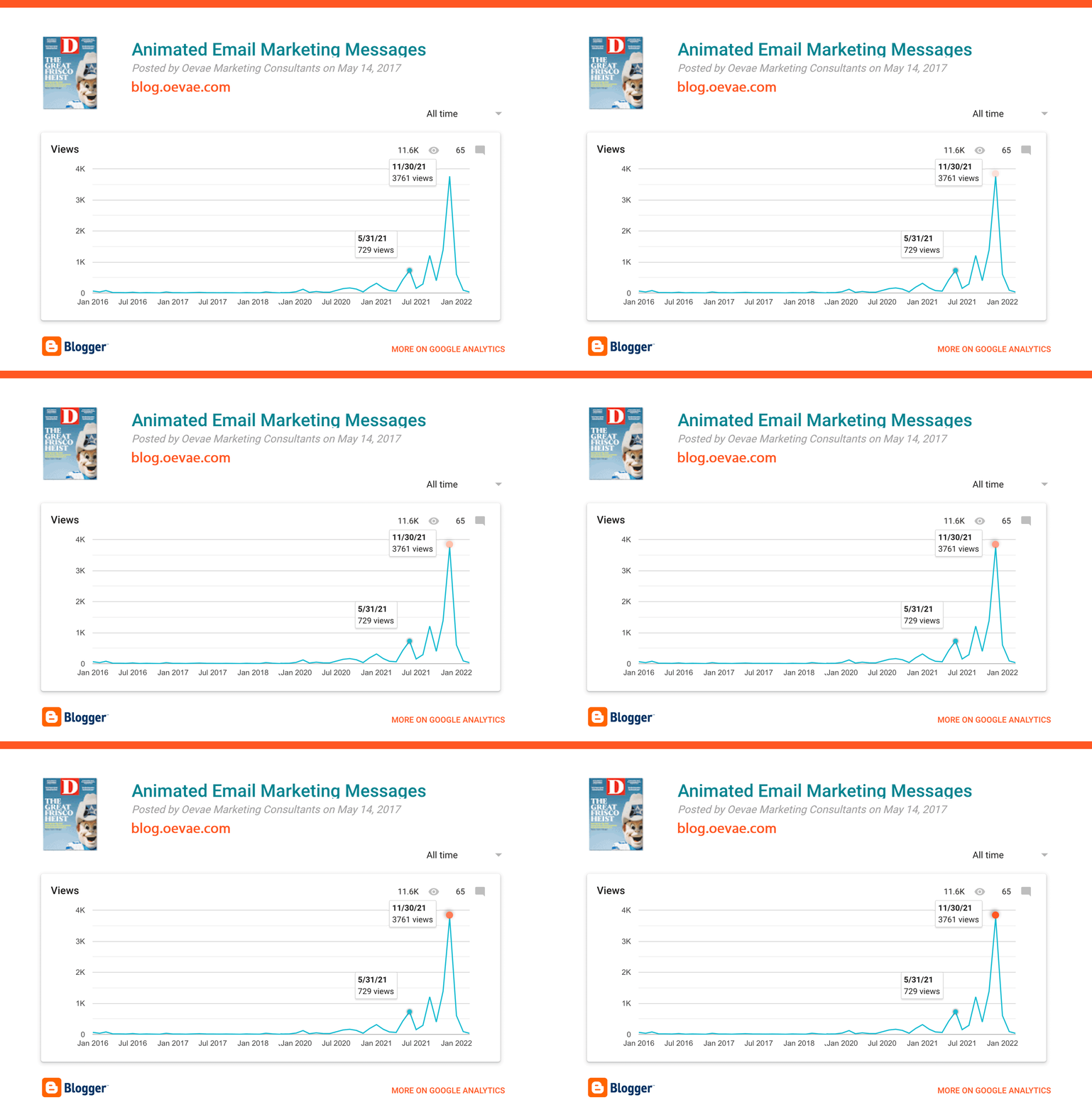
Ok, that sounds great and all, but I'm talking about a business blog. If you don't have a business blog you'll probably reconsider after exploring the benefits. The bigger question is how do you know if it's working and doing what it's supposed to do?  Easy. Since each blog post becomes a seed scattered on fertile ground.  The number of views for each blog post will grow over time.  This will tell you the overall appeal, meanwhile providing data that can help build a human aspect for your brand and build relationships with consumers – create household brand names (Kleenex, Scotch Tape, Xerox, Google, Popsicle, Ziploc).  Experienced examination of analytics will reveal which blog posts are compounding against those that need additional grooming versus those you should delete.

The top five benefits your business blog offers:

  1. Provide answers to common questions you receive about your brand
  2. Help establish and strengthen brand values with supporting photography
  3. Create a position of authority and leadership for your brand
  4. Convert visitor traffic into leads with long-term results
  5. Drive targeted organic traffic to your website

The research behind blogs and what a well-written blog can do to help a business grow is no mystery.  The reality is the vast number of small business owners have no clue or no experience at leveraging best practices that yield legitimate results.

A blog is the human voice of your brand.  So it is imperative for building a brand a consumer will listen to, understand or learn from, trust, and are willing to share their experience with friends, family, and in Google reviews.  Without a business blog to create regular content about your brand, you miss out on the benefits of compounding (posts whose traffic grows steadily over time) blog content.  As a compounding post generates more traffic, its search authority and hits increase, and more traffic becomes a virtuous growth cycle.

A high-performing business blog works tirelessly as an advocate for your brand, available all hours of the day, even on days, you don't want to work.  The blog for a business is often on the company website, shared on social media, linked from Google business profile, delivered in an email newsletter, sent via text messages, and scanned from QR codes. Each one can maximize the potential for a growing number of website visitors over time.  The best time to start a business blog was the day you started your business, the second-best time to start a business blog is now.

Make a brand difference.™